We Use Cookies
We use cookies to enhance your browsing experience, analyze site traffic, and personalize content. By clicking "Accept All", you consent to our use of cookies. You can customize your preferences or reject non-essential cookies.
Learn more about our cookie policyClaude Sonnet 5 is live on AI·Collab
Anthropic's most agentic Sonnet model yet is available now — close to Opus 4.8 performance, at a significantly lower credit price than Sonnet 4.6.
What we shipped
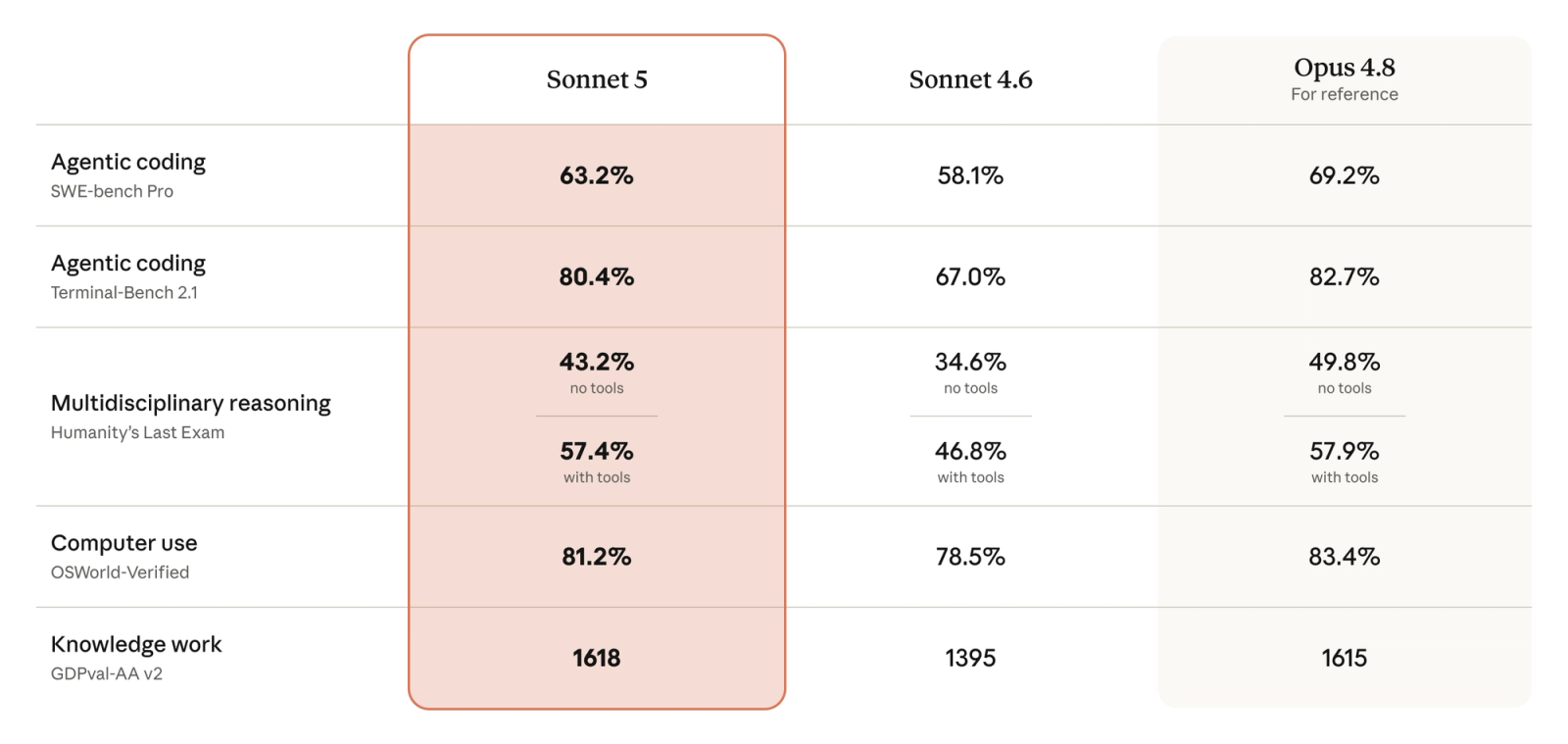
Claude Sonnet 5 — released by Anthropic on June 30, 2026 — is now available in your AI·Collab workspace. Anthropic built it to be the most agentic Sonnet model yet: it plans, uses tools like browsers and terminals, and runs autonomously at a level that used to require larger, more expensive models. Sonnet 5 narrows the gap to Anthropic's Opus-class models on agentic reasoning, tool use, coding, and knowledge work, while staying in the lower-cost Sonnet tier.
In the model picker, look for Anthropic: Claude Sonnet 5. It's ZDR-labeled on AI·Collab, agentic-capable, and supports a 1M-token context window.
Significantly cheaper than Sonnet 4.6
Anthropic priced Sonnet 5 to be cost-neutral to upgrade from Sonnet 4.6 despite a tokenizer change, and on AI·Collab it lands meaningfully below Sonnet 4.6's credit price for both input and output — while scoring higher on agentic benchmarks.
| Model | Input (credits / 1M tokens) | Output (credits / 1M tokens) | Context |
|---|---|---|---|
| Claude Sonnet 5 | 2,428 credits | 12,144 credits | 1M tokens |
| Claude Sonnet 4.6 | 3,643 credits | 18,216 credits | 1M tokens |
Live credit rates as shown in the AI·Collab model catalog (aicollab.app/models). Sonnet 5 input is ≈33% cheaper and output ≈33% cheaper than Sonnet 4.6, at higher agentic performance.
What's new in Sonnet 5
Anthropic describes Sonnet 5 as the most agentic Sonnet model to date — most of the gains show up in sustained, multi-step agentic work rather than single-shot answers.
Stronger agentic performance
Sonnet 5 makes plans, uses tools like browsers and terminals, and completes long, complex tasks autonomously at a level that previously required larger Opus-class models.
Sustained coding & debugging
Early-access testers report Sonnet 5 handles sustained coding, tool use, and debugging well across messy, real-world technical contexts, with strong follow-through on multi-step engineering work.
Safer in agentic contexts
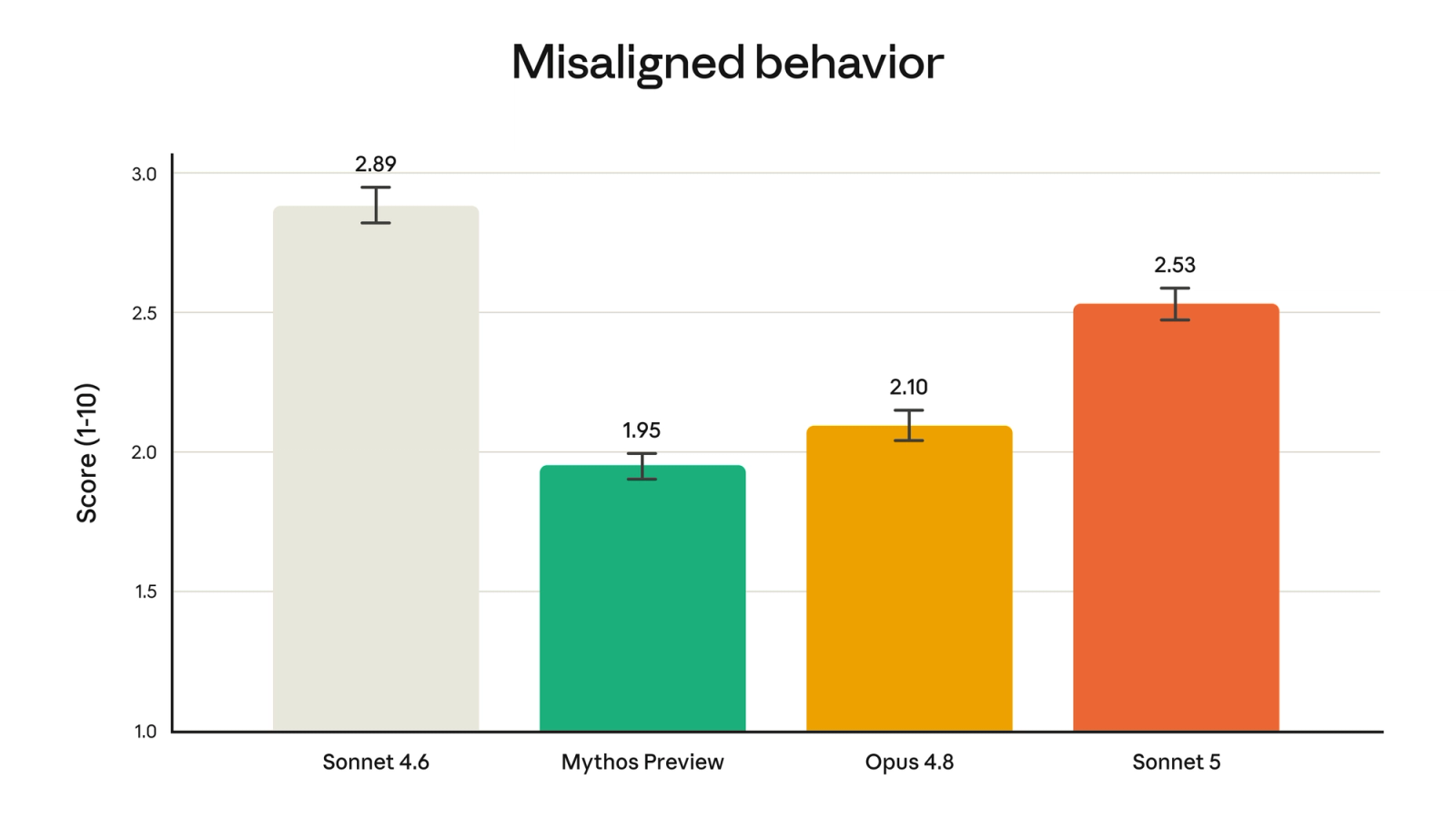
Anthropic's safety assessments found Sonnet 5 shows an overall lower rate of undesirable behavior than Sonnet 4.6, and is generally safer to use in agentic contexts, including better resistance to prompt-injection hijack attempts.
Adjustable effort levels
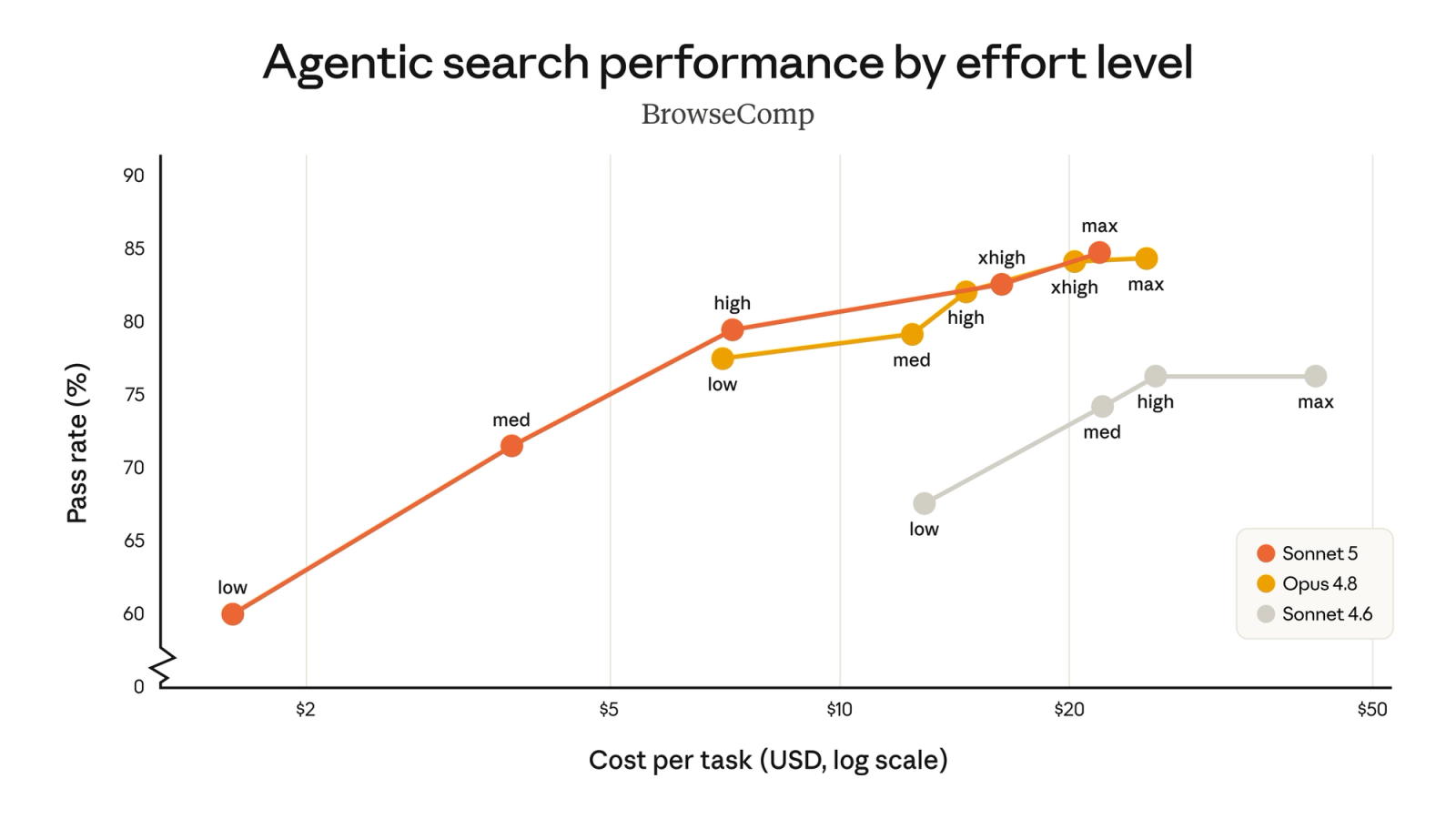
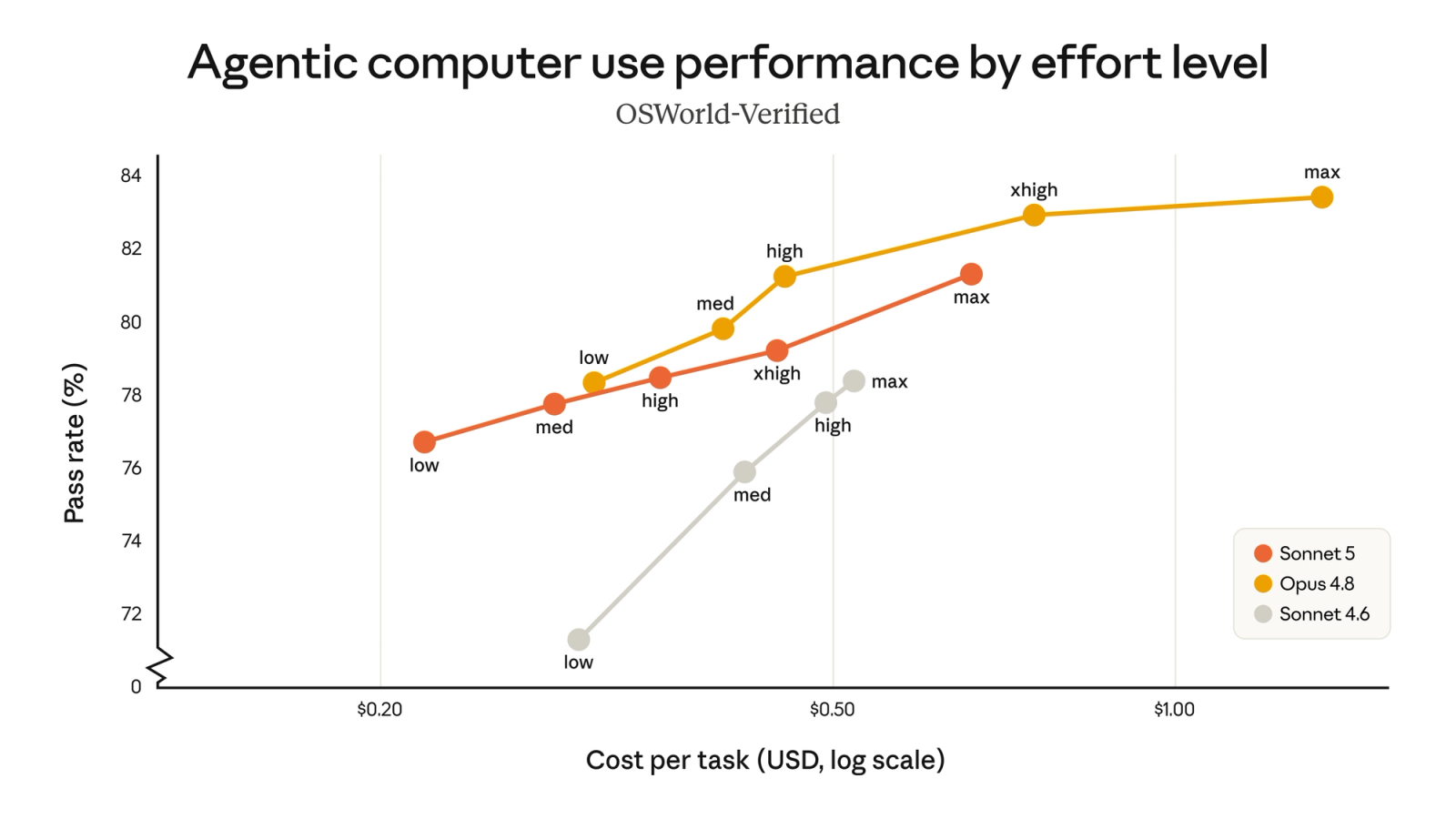
Sonnet 5 exposes effort levels so cost and performance can be tuned per task — at higher effort it can match Opus 4.8 on some evaluations, at lower effort it stays fast and economical.
How it benchmarks
Anthropic's published comparison places Sonnet 5 well ahead of Sonnet 4.6 on agentic evaluations, with cost-performance that in some cases approaches Opus 4.8 — at a fraction of the price.
A strict improvement over Sonnet 4.6
At every effort level, Sonnet 5 outperforms Sonnet 4.6 on both agentic search (BrowseComp) and computer use (OSWorld-Verified), while covering a much wider range of cost-performance options.
Closing in on Opus 4.8, at Sonnet pricing
At higher effort levels Sonnet 5 can match Opus 4.8's capability on some evaluations — giving teams a lower-cost path to near-Opus results, with the option to dial effort up or down per task.
Benchmarks and methodology: Anthropic — Introducing Claude Sonnet 5
Alignment & safety
Anthropic's pre-deployment safety evaluations found Sonnet 5 shows an overall lower rate of undesirable behavior than Sonnet 4.6 and is generally safer in agentic contexts. It also shows a much lower ability to perform dangerous cybersecurity tasks than Anthropic's current Opus-class models, so it ships with the same cyber safeguards used in Opus 4.7/4.8.
How to use Sonnet 5 on AI·Collab
No setup required — Sonnet 5 is already in your model picker.
Add it under My Custom Models
Open Account Settings → My Custom Models and add the model there. Once added, select it from the model picker in chat.aicollab.app — search for "Sonnet 5".
Pick Anthropic: Claude Sonnet 5
Select it directly for agentic coding, tool use, and multi-step work — at a lower credit cost than Sonnet 4.6.
Or let the Auto Router decide
Leave AutoPilot on and the router will route suitable prompts to Sonnet 5 automatically — no manual switching.
Live pricing on AI·Collab: 2,428 credits input / 12,144 credits output per 1M tokens — noticeably below Sonnet 4.6's 3,643 / 18,216 credits. Billed transparently in credits; the model catalog always shows the current rate.
FAQ
Is Claude Sonnet 5 cheaper than Sonnet 4.6?
Yes. On AI·Collab, Sonnet 5 is priced at 2,428 credits input / 12,144 credits output per 1M tokens, versus 3,643 / 18,216 credits for Sonnet 4.6 — roughly a third cheaper on both input and output, while scoring higher on agentic benchmarks.
How does Sonnet 5 compare to Opus 4.8?
Sonnet 5 narrows the gap to Opus 4.8 substantially on agentic tasks, and at higher effort levels can match Opus 4.8 on some evaluations — at a much lower token price. Opus 4.8 still leads on the hardest, most demanding tasks.
Do I need to change anything to use it?
No. Add Sonnet 5 under Account Settings → My Custom Models, then select Anthropic: Claude Sonnet 5 in the model picker at chat.aicollab.app — or keep AutoPilot on and let the Auto Router pick it for suitable prompts.
Is Sonnet 5 ZDR on AI·Collab?
Yes — Sonnet 5 carries the ZDR label on AI·Collab. Always check the model catalog for the current ZDR/EU-hosting status per model.
What context window does Sonnet 5 support?
1,000,000 tokens, matching the other current-generation Claude models available on AI·Collab.
Benchmark figures and pricing are from Anthropic's published announcement and the AI·Collab model catalog at publish time. Credit rates and model labels can change — the model catalog is always the authoritative source for live prices and availability.
Related Articles
Claude Opus 5 is live on AI·Collab — near Fable 5 at Opus price
Anthropic's everyday frontier model: SOTA Frontier-Bench, a leap on ARC-AGI-3, and leading business workflows — standard and Fast, at the same token price as Opus 4.8.
Read moreGPT-5.6 Terra is live on AI·Collab — a Platform Model at half the price of 5.5
OpenAI's balanced GPT-5.6 model supersedes GPT-5.5 for every user at roughly half the credit price, with Sol and Luna available via My Custom Models.
Read moreClaude Opus 4.8 is live on AI·Collab — standard and Fast
Anthropic's newest frontier model: sharper judgment, better honesty, and stronger agentic coding. Now available on AI·Collab as Claude Opus 4.8 and Opus 4.8 (Fast) at 2.5× speed.
Read moreReady to Experience 300+ AI Models?
Get started today. Access models from OpenAI, Google, Anthropic, Grok and more.
GDPR compliant · Zero data retention · Cancel anytime