We Use Cookies
We use cookies to enhance your browsing experience, analyze site traffic, and personalize content. By clicking "Accept All", you consent to our use of cookies. You can customize your preferences or reject non-essential cookies.
Learn more about our cookie policyClaude Opus 5 is live on AI·Collab
Anthropic's everyday frontier model — near Fable 5 intelligence at Opus price. Available as Claude Opus 5 and Opus 5 (Fast), with stronger agentic coding, novel problem-solving, and business workflows.
What we shipped
Claude Opus 5 — released by Anthropic on July 24, 2026 — is now available in your AI·Collab workspace. Anthropic positions it as a thoughtful, proactive everyday model that comes close to Claude Fable 5's frontier intelligence at half Fable's price (and the same token price as Opus 4.8). On coding and knowledge-work evaluations such as Frontier-Bench and GDPval-AA, Opus 5 is the new state of the art among generally available models Anthropic compared — while remaining behind Mythos 5 on cybersecurity exploitation tasks.
In the model picker, look for Anthropic: Claude Opus 5 and Anthropic: Claude Opus 5 (Fast). Both support agentic workflows — memory, tool-calling, web search, and long-horizon tasks — as you'd expect from the Opus line.
Near Fable 5 — at Opus price
Opus 5 ships at $5 / $25 per million input / output tokens — the same as Opus 4.8, and half the list price of Claude Fable 5 ($10 / $50). Fast mode runs at ~2.5× speed for $10 / $50. Live credit rates are always on the model catalog.
Unlike Mythos-class Fable 5 (NON-ZDR / 30-day safety retention), Opus 5 has no general-access data-retention requirement from Anthropic — consistent with prior Opus models.
What's new in Opus 5
The jump from Opus 4.8 is largest where judgment, verification, and end-to-end completion matter — not just single-turn answers.
State-of-the-art agentic coding
43.3% on Frontier-Bench v0.1 — more than double Opus 4.8 (21.1%) and ahead of Fable 5 (33.7%) and GPT-5.6 Sol (34.4%) in Anthropic's published comparison. Stronger at finding root causes and finishing hard engineering tasks.
Novel problem-solving
30.2% on ARC-AGI-3 — about three times the next-best model in Anthropic's table (GPT-5.6 Sol 7.8%, Opus 4.8 1.5%). Opus 5 is far better at unfamiliar problems that need inventiveness, not memorised patterns.
Business workflows & computer use
26.0% on AutomationBench (≈1.5× the next-best model) and 70.6% on OSWorld 2.0 for computer use — leading Anthropic's published cost-aware comparisons for end-to-end business tasks and desktop agents.
Effort control & Fast mode
Tune intelligence vs. tokens with effort settings. On AI·Collab, pick standard Opus 5 for maximum quality or Opus 5 (Fast) at ~2.5× speed for interactive work — same trade-off pattern as Opus 4.8.
How it benchmarks
Anthropic's published table places Opus 5 ahead of Opus 4.8 across most capabilities, and competitive with or ahead of Fable 5 and GPT-5.6 Sol on several agentic and knowledge-work metrics — often at lower cost per task.
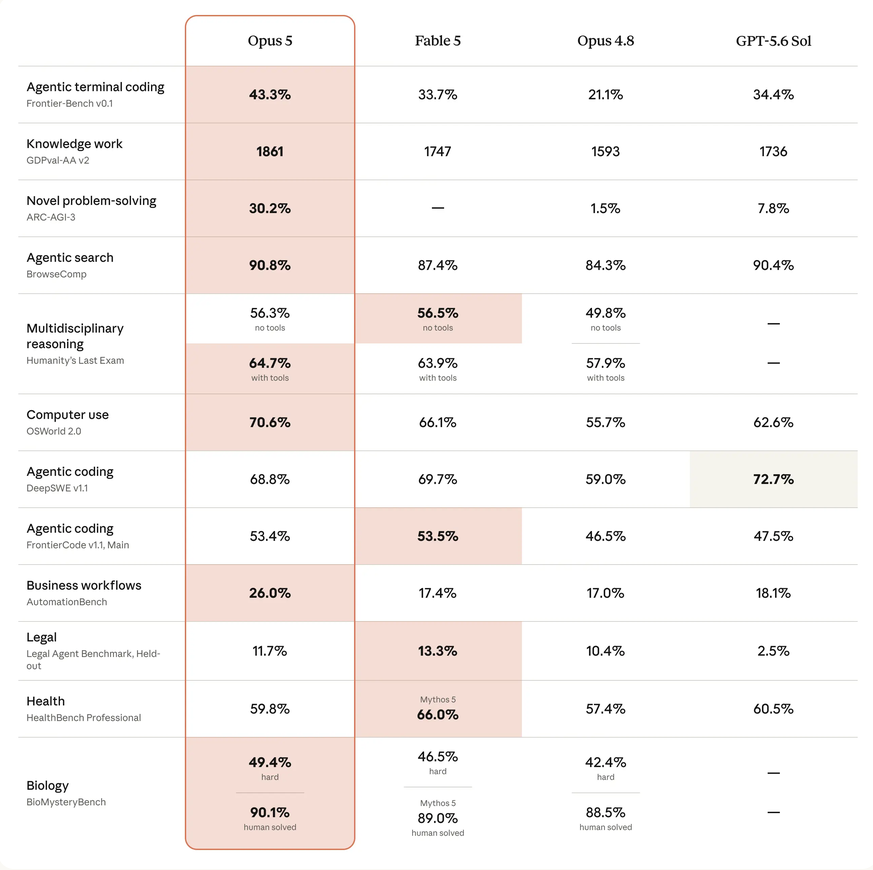
Agentic terminal coding — Frontier-Bench v0.1: 43.3%
New state of the art in Anthropic's comparison — ahead of Fable 5 (33.7%), GPT-5.6 Sol (34.4%) and more than double Opus 4.8 (21.1%), at the same Opus token price.
Novel problem-solving — ARC-AGI-3: 30.2%
A step-change vs. Opus 4.8 (1.5%) and GPT-5.6 Sol (7.8%). Anthropic highlights this as roughly 3× the next-best model on unfamiliar problems.
Business workflows — AutomationBench: 26.0%
About 1.5× the next-best model at comparable cost. Even at low effort, Anthropic reports Opus 5 passing more end-to-end business tasks than competing models.
Computer use — OSWorld 2.0: 70.6%
Leads Anthropic's published OSWorld 2.0 comparison (Fable 5 66.1%, GPT-5.6 Sol 62.6%, Opus 4.8 55.7%), with strong cost-efficiency vs. higher-priced frontier models.
Benchmarks and methodology: Anthropic — Introducing Claude Opus 5
Benchmark table © Anthropic, reproduced from the official Claude Opus 5 announcement (anthropic.com/news/claude-opus-5) for editorial reference.
Alignment & safety
Anthropic reports Opus 5 as their most aligned generally available model to date on automated behavioral audits — stronger adherence to Claude's Constitution than Opus 4.8, Sonnet 5 or Fable 5, with lower rates of deceptive behavior and fewer reckless side-effect actions. It does not advance the risky dual-use frontier: it remains behind Mythos 5 on offensive cybersecurity exploitation and long-running autonomous biology research. Cyber classifiers allow source-code vulnerability finding but block binary-based scanning, penetration testing and exploit generation. When classifiers fire on Claude products, requests can fall back to Opus 4.8.
How to use Opus 5 on AI·Collab
Add the model under My Custom Models, then pick standard or Fast for the job.
Add it under My Custom Models
Open Account Settings → My Custom Models and add Claude Opus 5. Once added, select it in the model picker at chat.aicollab.app — search for "Opus 5".
Choose standard or Fast
Pick Anthropic: Claude Opus 5 for maximum quality on hard coding, research and agentic work, or Opus 5 (Fast) for ~2.5× faster responses in interactive and high-volume sessions.
Or let the Auto Router decide
Leave AutoPilot on and the router can send suitable prompts to Opus-class quality automatically — no manual switching.
Standard Opus 5: $5 / $25 per million input / output tokens (same as Opus 4.8). Fast mode: $10 / $50 per million at ~2.5× speed. Billed in credits on AI·Collab — the model catalog always shows the live rate.
FAQ
What's the difference between Opus 5 and Opus 5 (Fast)?
Same underlying model. Standard prioritises maximum quality; Fast runs at roughly 2.5× the speed for interactive work and costs $10 / $50 per 1M input / output tokens vs. $5 / $25 for standard.
How does Opus 5 compare to Claude Fable 5?
Anthropic says Opus 5 comes close to Fable 5's frontier intelligence at half Fable's price. Fable 5 remains Mythos-class and NON-ZDR (30-day safety retention). Opus 5 keeps Opus pricing and has no general-access retention requirement. For the absolute hardest long-horizon work, Fable may still win; for everyday frontier quality at Opus cost, Opus 5 is the practical default.
Is Opus 5 better than Opus 4.8?
Yes — substantially on Anthropic's published agentic coding, novel problem-solving, business-workflow and computer-use benchmarks, with the same standard token price. It also verifies and iterates more carefully before handing work back.
Is Opus 5 ZDR on AI·Collab?
Anthropic states Opus 5 has no data-retention requirements for general access (unlike Mythos-class Fable 5). Always check the live ZDR/EU label on each model card in the catalog — labels can change with routing.
Is Opus 5 available EU-hosted?
This launch uses Anthropic's standard path. For EU data-residency needs, AI·Collab also offers EU-hosted Claude models on Azure Sweden Central — see our EU model expansion post. Check the catalog for current EU badges.
How is it billed on AI·Collab?
In credits. Exact credit rates for Opus 5 and Opus 5 (Fast) are on each model card in the catalog.
Sources & further reading
- Anthropic — Introducing Claude Opus 5 (official announcement)
- AI·Collab blog — Claude Opus 4.8 is live on AI·Collab
- AI·Collab blog — Claude Fable 5 is live on AI·Collab
- AI·Collab blog — GPT-5.6 Terra is live on AI·Collab
- AI·Collab blog — What Are Credits, and What Do I Get for Them?
- AI·Collab — browse the full model catalog
Benchmark figures are from Anthropic's published Claude Opus 5 announcement (July 24, 2026) and have not been independently verified by AI·Collab. The benchmark table is © Anthropic, reproduced for editorial reference. Credit rates and model labels can change — the model catalog is always the authoritative source for live prices and availability.
Related Articles
Claude Fable 5.1 is live on AI·Collab — new frontier, ~25% cheaper to run
Anthropic's strongest model yet: ahead of Opus 5 on every benchmark, double Fable 5 on agentic science — and cheaper in practice thanks to a 75% cut in cache-read pricing. Plus what NON-ZDR means for your data.
Read moreClaude Fable 5 is live on AI·Collab — Anthropic's Mythos-class debut
Anthropic's most capable model ever, available on AI·Collab from launch day: 80.3% on SWE-Bench Pro, state-of-the-art in knowledge work and vision — plus what NON-ZDR means for your data.
Read moreGPT-5.6 Terra is live on AI·Collab — a Platform Model at half the price of 5.5
OpenAI's balanced GPT-5.6 model supersedes GPT-5.5 for every user at roughly half the credit price, with Sol and Luna available via My Custom Models.
Read moreReady to Experience 300+ AI Models?
Get started today. Access models from OpenAI, Google, Anthropic, Grok and more.
GDPR compliant · Zero data retention · Cancel anytime