We Use Cookies
We use cookies to enhance your browsing experience, analyze site traffic, and personalize content. By clicking "Accept All", you consent to our use of cookies. You can customize your preferences or reject non-essential cookies.
Learn more about our cookie policyClaude Fable 5.1 is live on AI·Collab
Anthropic's new frontier model: ahead of Opus 5 on every published benchmark, more than double Fable 5 on agentic science — and around 25% cheaper to run thanks to a 75% cut in cache-read pricing. Available on AI·Collab from launch.
What we shipped
Claude Fable 5.1 — released by Anthropic on September 1, 2026 — is available on AI·Collab now. It is the successor to Fable 5 in Anthropic's Mythos class and, according to Anthropic, the world's most advanced model for coding and knowledge work. The headline is twofold: Fable 5.1 sets a new performance frontier (it beats Claude Opus 5 on every benchmark Anthropic published, reversing the cases where Opus 5 had led), and it is cheaper to run than Fable 5 for the same workloads — Anthropic estimates ~25% less on typical usage and up to ~45% less on highly agentic, context-heavy work.
In the model picker, search for "Fable" — Anthropic: Claude Fable 5.1. Memory, tool-calling, web search and long-horizon agentic workflows work as you'd expect. Fable 5 remains available alongside it.
Same list price — but ~25% to ~45% cheaper in practice
Fable 5.1 keeps Fable 5's token pricing: $10 per million input tokens and $50 per million output tokens. What changed is cache reads — the model re-reading context it has already processed. Anthropic cut that price by 75%, from $1.00 to $0.25 per million tokens. Because long agentic sessions are dominated by cache reads, Anthropic measured a ~25% cost reduction on typical workloads and ~45% on highly agentic ones over four weeks of real usage in August 2026. The model catalog always shows the live credit rate.
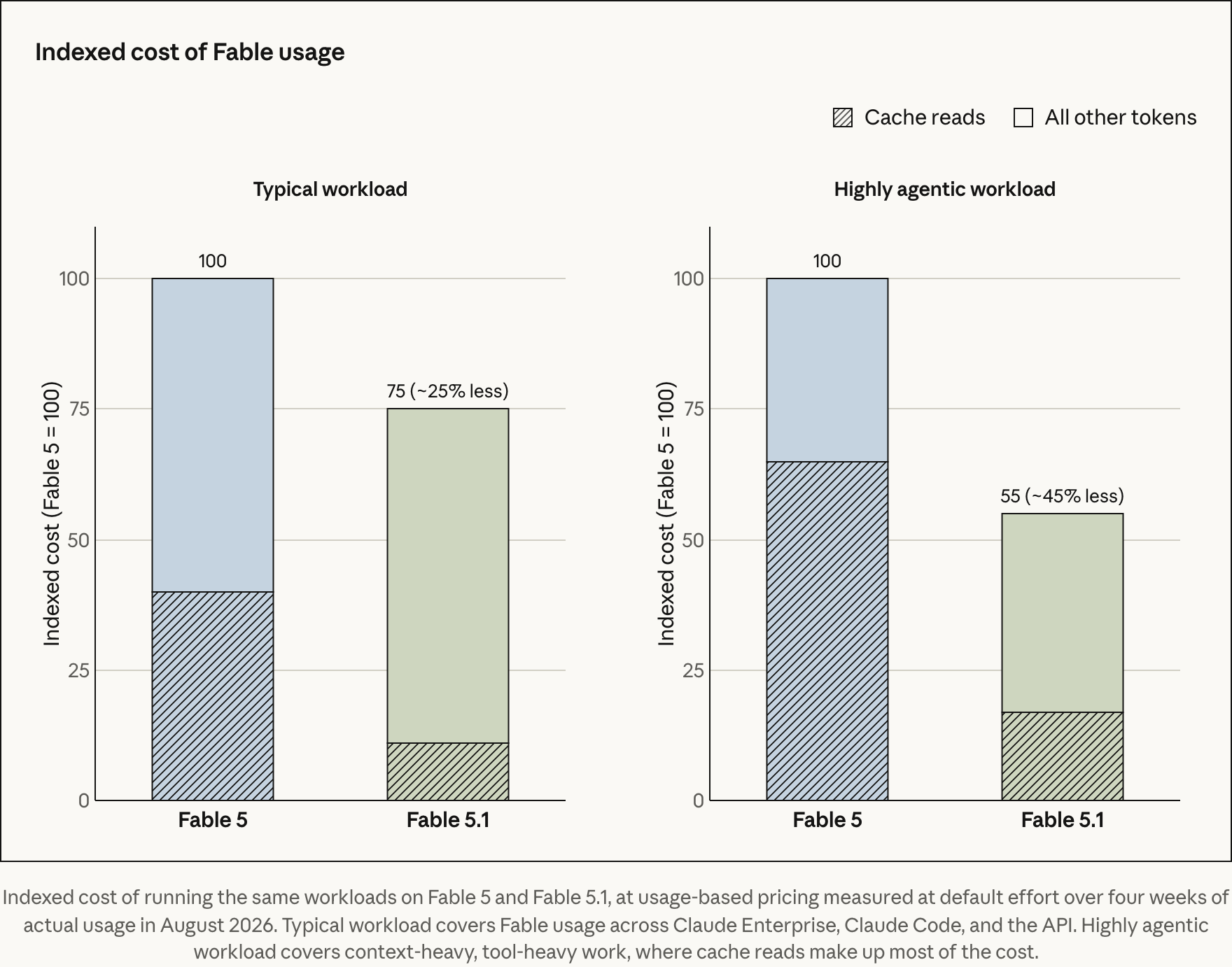
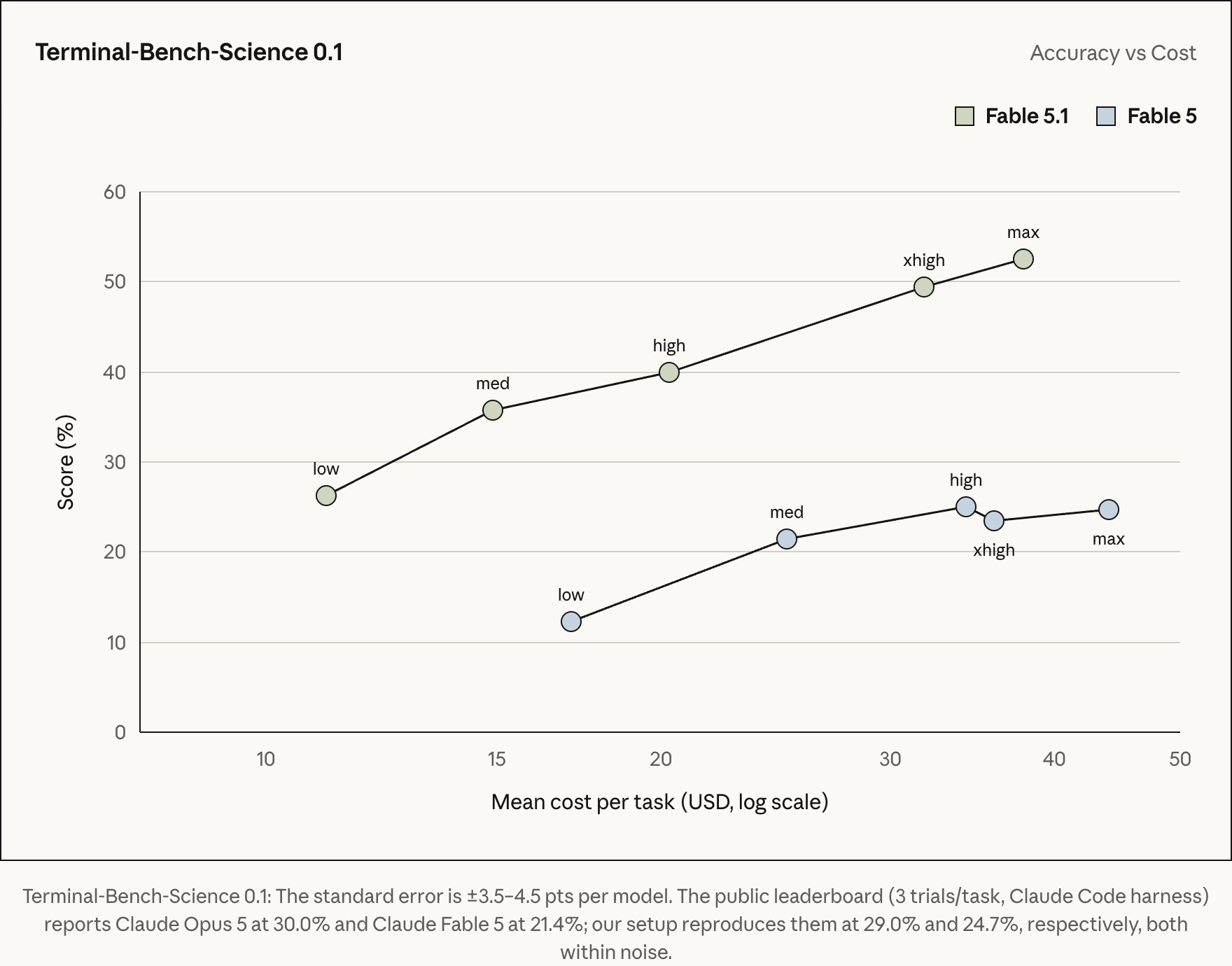
Effort control matters too: at Low or Medium effort, Fable 5.1 reaches results similar to or better than Fable 5 at a fraction of the cost. Batch pricing ($5 / $25) is unchanged.
What's new in Fable 5.1
The gains are largest on long-running, agentic work — scientific research, terminal coding, end-to-end business tasks — and smallest on academic reasoning. Early testers report it stays readable over long multi-step runs and fixes root causes instead of taking shortcuts.
Agentic scientific research
52.6% on Terminal-Bench-Science 0.1 — more than double Fable 5 (24.7%) and well ahead of Opus 5 (29.0%) and GPT-5.6 Sol (22.4%). Fable 5.1 trained a neural network that produced a new high-resolution elevation map for a third of Venus from 30-year-old NASA Magellan radar data.
Agentic terminal & IDE coding
55.8% on Terminal-Bench 4.0 (Fable 5: 42.0%, Opus 5: 52.3%) and 73.4% on CursorBench 3.2.0 — the top score any model has posted there. Millennium reports it found the cause of a one-in-a-million crash that no engineer or model had explained in four to five years.
Business workflows & knowledge work
31.4% on AutomationBench — up from 17.1% for Fable 5 and ahead of Opus 5 (26.9%). GDPval-AA v2 rises to 1853 (Fable 5: 1723, Opus 5: 1824). Hebbia reports the best slide decks and financial fact recall of any model they tested.
Long, unattended runs
Ramp describes a 38-hour unattended ML run that diagnosed a label artifact, corrected it, launched six parallel experiments overnight and came back with results. Shopify and MongoDB report multi-hour workflows that keep their own records and pick up where they left off.
How it benchmarks
Anthropic's published table compares Fable 5.1 with Fable 5, Opus 5 and GPT-5.6 Sol. Fable 5.1 leads every row; the largest jumps are on agentic science and business workflows, the smallest on IDE coding and expert reasoning. Independently, Artificial Analysis rates Fable 5.1 at 66 on its Intelligence Index (Opus 5: 63, GPT-5.6 Sol: 61).
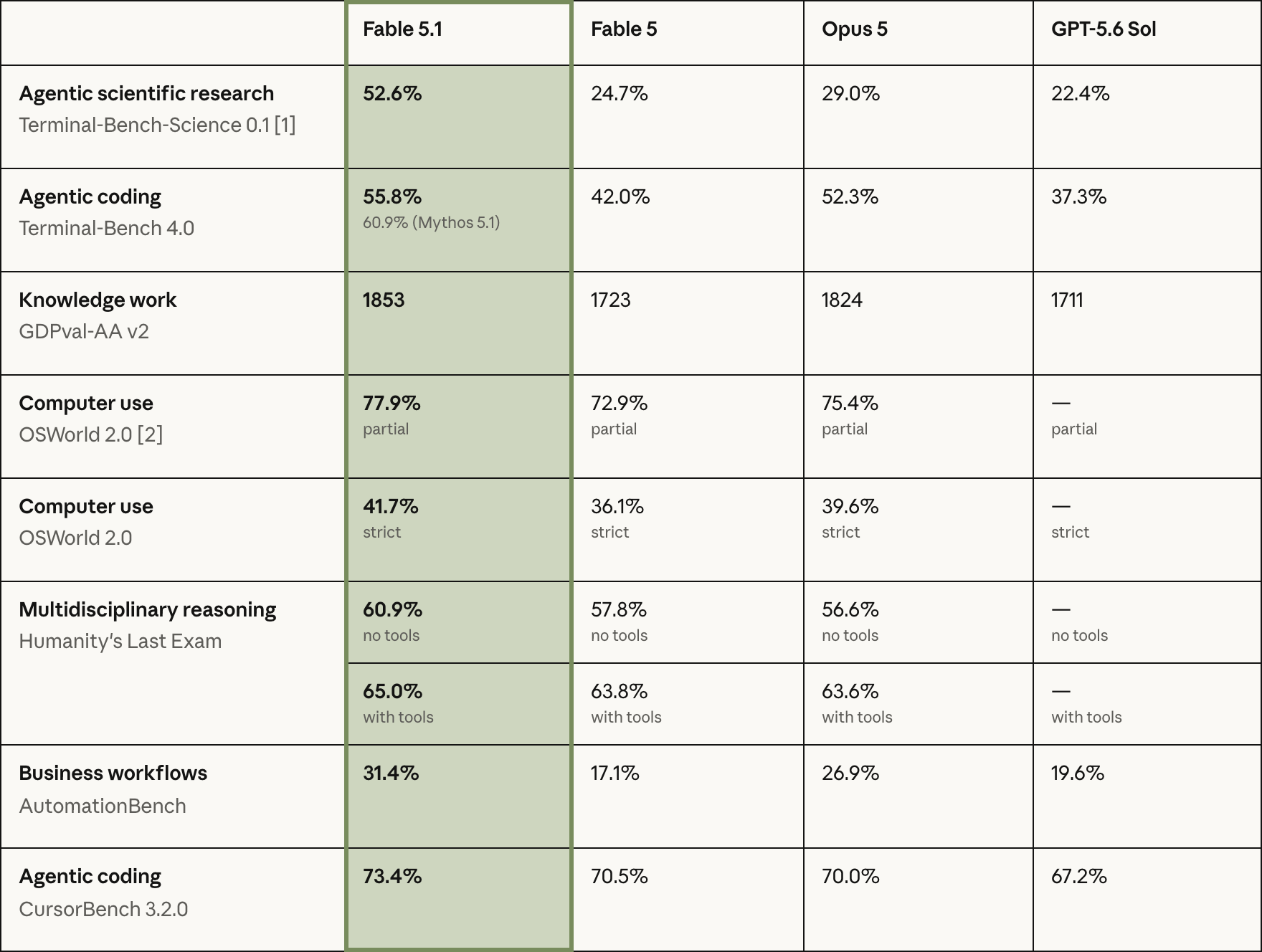
Agentic scientific research — Terminal-Bench-Science 0.1: 52.6%
More than double Fable 5 (24.7%) and far ahead of Opus 5 (29.0%) and GPT-5.6 Sol (22.4%). The benchmark covers 70 scientist-contributed workflows across the life, physical, Earth, mathematical and engineering sciences; Anthropic states a standard error of ±3.5–4.5 points.
Agentic coding — Terminal-Bench 4.0: 55.8% · CursorBench 3.2.0: 73.4%
Terminal-Bench 4.0 rises from 42.0% (Fable 5) to 55.8%; the unrestricted Mythos 5.1 reaches 60.9%. On CursorBench, Fable 5.1 scores 73.4% vs. 70.5% for Fable 5 and 70.0% for Opus 5 — a lead, but a narrow one for everyday IDE work.
Business workflows — AutomationBench: 31.4%
An 84% relative improvement over Fable 5 (17.1%) and ahead of Opus 5 (26.9%) and GPT-5.6 Sol (19.6%) on end-to-end business tasks. Computer use also improves: OSWorld 2.0 77.9% partial / 41.7% strict (Fable 5: 72.9% / 36.1%).
Knowledge work & reasoning — GDPval-AA v2: 1853 · HLE: 65.0% with tools
A 130-Elo gain over Fable 5 (1723) on economically valuable knowledge work. Humanity's Last Exam reaches 60.9% without tools and 65.0% with tools (Fable 5: 57.8% / 63.8%).
Benchmarks and methodology: Anthropic — Introducing Claude Fable 5.1 and Claude Mythos 5.1
Benchmark table and charts © Anthropic, reproduced from the official Claude Fable 5.1 announcement (anthropic.com/claude-fable-and-mythos-5-1) for editorial reference.
More precise safeguards, fewer false positives
Fable 5.1 ships with the same safeguard architecture as Fable 5 — classifiers for cybersecurity, biology/chemistry and model distillation — but they have become considerably more precise. Anthropic reports around 60% fewer cyber-safeguard interventions per session, and the updated biology safeguards fire 85% less often on benign medical and elementary biology questions. Fable 5.1 may now also be used to identify software vulnerabilities in source code — defensive security work — though not to develop exploits.
When a safeguard still triggers, the request is answered by Claude Opus 5 instead (previously Opus 4.8), and you are informed in the chat. Dual-use tasks such as penetration testing, exploit generation, binary vulnerability scanning and professional life-sciences R&D continue to be redirected. A fallback to Opus 5 is a frontier-quality answer — not a refusal.
Transparency: why Fable 5.1 is NON-ZDR
Like Fable 5, Claude Fable 5.1 carries the NON-ZDR badge on AI·Collab. Anthropic requires 30-day data retention for Mythos-class traffic on every platform — a deliberate safety measure that helps them detect novel jailbreaks and attacks operating across many requests. Anthropic has announced Enterprise Frontier Safeguards (EFS), which will eventually give enterprise customers zero-data-retention privacy by keeping data in customer-controlled infrastructure; it rolls out in phases starting this fall and does not yet change the label on AI·Collab.
Anthropic's commitments stay the same: the data is never used to train new models, never used for any non-safety purpose, all human access is logged, and deletion after 30 days is ensured in almost all cases. Our ZDR models — the large majority of our catalog — remain fully zero-data-retention. The choice is always yours, per chat, per task.
How ZDR works on AI·CollabHow to use Fable 5.1 on AI·Collab
Fable 5.1 is available to all AI·Collab users from today. Add it once, then pick it whenever a task justifies frontier quality.
Add it under My Custom Models
Open Account Settings → My Custom Models and add Claude Fable 5.1. Then select it from the model picker at chat.aicollab.app — search for "Fable 5.1".
Give it long, agentic work
Fable 5.1 shines on multi-step research, large codebases, root-cause debugging and unattended agent runs — exactly the workloads where the cache-read discount saves the most. For everyday IDE-style coding, Opus 5 at half the list price remains a strong, cheaper choice.
Know your data choice
Fable 5.1 is NON-ZDR (30-day Anthropic safety retention). For zero-retention work, pick any of our ZDR-badged models — they remain the default recommendation for sensitive data.
Pricing: $10 / $50 per million input / output tokens — the same as Fable 5 — with cache reads now $0.25 per million (was $1.00). Batch: $5 / $25.
Frequently asked questions
How is Fable 5.1 different from Fable 5?
Same model class, clearly stronger: Fable 5.1 more than doubles Fable 5 on agentic scientific research (52.6% vs. 24.7%), improves terminal coding from 42.0% to 55.8% and business workflows from 17.1% to 31.4%. It is also cheaper to run — the same list price, but cache reads cost 75% less, which Anthropic estimates saves ~25% on typical and up to ~45% on agentic workloads. Fable 5 stays available on AI·Collab.
Should I use Fable 5.1 or Opus 5?
Fable 5.1 leads Opus 5 on every published benchmark, but the gap varies: large on agentic science and business workflows, only about three points on IDE-style coding (CursorBench 73.4% vs. 70.0%). Opus 5 costs half the list price ($5 / $25), is faster and has no retention requirement. Use Fable 5.1 for long, unattended, research-heavy agent work; Opus 5 for everyday coding and knowledge work.
Why does Fable 5.1 have the NON-ZDR badge?
Anthropic requires 30-day data retention for all Mythos-class traffic, on all platforms, strictly for safety monitoring. The data is never used for training, all human access is logged, and deletion after 30 days is ensured in almost all cases. Anthropic's upcoming Enterprise Frontier Safeguards may change this for enterprise customers later this year; until then the label stays. If you need zero data retention, choose one of our many ZDR-badged models — details at aicollab.app/zdrp/.
What happens when a safeguard triggers?
Your request is automatically answered by Claude Opus 5 instead of Fable 5.1, and you are informed in the chat. With the improved classifiers this happens around 60% less often for cyber topics and 85% less often for benign biology and medical questions than with Fable 5. Opus 5 is a frontier model in its own right, so you still get a high-quality answer.
What does Fable 5.1 cost on AI·Collab?
Anthropic prices Fable 5.1 at $10 per million input tokens and $50 per million output tokens — identical to Fable 5 — with cache reads reduced to $0.25 per million. Exact credit rates are on the models page.
Is Claude Mythos 5.1 available on AI·Collab?
No. Mythos 5.1 is the same model with more permissive safeguards and is restricted to vetted cyberdefense and life-sciences organisations through Anthropic's Cyber Verification Program and Life Sciences Verification Program. Fable 5.1 — the generally available version — is live on AI·Collab now.
Sources & further reading
- Anthropic — Introducing Claude Fable 5.1 and Claude Mythos 5.1 (official announcement)
- AI·Collab blog — Claude Fable 5 is live on AI·Collab
- AI·Collab blog — Claude Opus 5 is live on AI·Collab
- AI·Collab — Zero Data Retention explained
- AI·Collab blog — What Are Credits, and What Do I Get for Them?
- AI·Collab — browse the full model catalog
Benchmark figures are from Anthropic's published Claude Fable 5.1 announcement (September 1, 2026) and have not been independently verified by AI·Collab. The benchmark table and charts are © Anthropic, reproduced for editorial reference. Cost savings are Anthropic's estimates and depend on your workload. Credit rates and model labels can change — the model catalog is always the authoritative source for live prices and availability.
Related Articles
Claude Fable 5 is live on AI·Collab — Anthropic's Mythos-class debut
Anthropic's most capable model ever, available on AI·Collab from launch day: 80.3% on SWE-Bench Pro, state-of-the-art in knowledge work and vision — plus what NON-ZDR means for your data.
Read moreClaude Opus 5 is live on AI·Collab — near Fable 5 at Opus price
Anthropic's everyday frontier model: SOTA Frontier-Bench, a leap on ARC-AGI-3, and leading business workflows — standard and Fast, at the same token price as Opus 4.8.
Read moreGPT-5.6 Terra is live on AI·Collab — a Platform Model at half the price of 5.5
OpenAI's balanced GPT-5.6 model supersedes GPT-5.5 for every user at roughly half the credit price, with Sol and Luna available via My Custom Models.
Read moreReady to Experience 300+ AI Models?
Get started today. Access models from OpenAI, Google, Anthropic, Grok and more.
GDPR compliant · Zero data retention · Cancel anytime