We Use Cookies
We use cookies to enhance your browsing experience, analyze site traffic, and personalize content. By clicking "Accept All", you consent to our use of cookies. You can customize your preferences or reject non-essential cookies.
Learn more about our cookie policyClaude Fable 5 is live on AI·Collab
Anthropic's most capable model ever — the first generally available Mythos-class model, a tier above Opus. State-of-the-art in coding, knowledge work, vision and research. Available on AI·Collab from launch day.
What we shipped
Claude Fable 5 — released by Anthropic on June 9, 2026 — is available on AI·Collab today. It is the first generally available model of the new Mythos class, a capability tier that sits above the Opus series. Anthropic states that Fable 5's capabilities exceed those of any model they have ever made generally available: state-of-the-art on nearly all tested benchmarks, with exceptional performance in software engineering, knowledge work, vision and scientific research. The longer and more complex the task, the larger Fable 5's lead.
In the model picker, search for "Fable" — Anthropic: Claude Fable 5. Memory, tool-calling and long-horizon workflows work as you'd expect.
What makes Fable 5 different
Fable 5 is not an incremental update — it is a new model class. Early testers report qualitative jumps: Stripe compressed a codebase migration from two months to a single day; Cursor calls it state-of-the-art on long-horizon problems that were previously out of reach.
Agentic coding
80.3% on SWE-Bench Pro — a clear lead over Opus 4.8 (69.2%), GPT 5.5 (58.6%) and Gemini 3.1 Pro (54.2%). Highest score on Cognition's FrontierCode while staying token-efficient.
Knowledge work
Top score on GDPval-AA (1932 vs. Opus 4.8's 1890). Highest score of any model on Hebbia's Finance Benchmark with substantial gains in document reasoning and chart interpretation.
Vision
New state-of-the-art for vision tasks: extracts precise numbers from scientific figures and can rebuild a web app's source code from screenshots alone — 29.8% on GDP.pdf vision tasks (Opus 4.8: 22.5%).
Memory & long-horizon focus
Stays focused across millions of tokens and improves its output using its own notes. With persistent memory, performance gains were three times larger than for Opus 4.8.
How it benchmarks
Anthropic's published comparison shows Fable 5 ahead of Opus 4.8, GPT 5.5 and Gemini 3.1 Pro on nearly every benchmark — often by a wide margin.
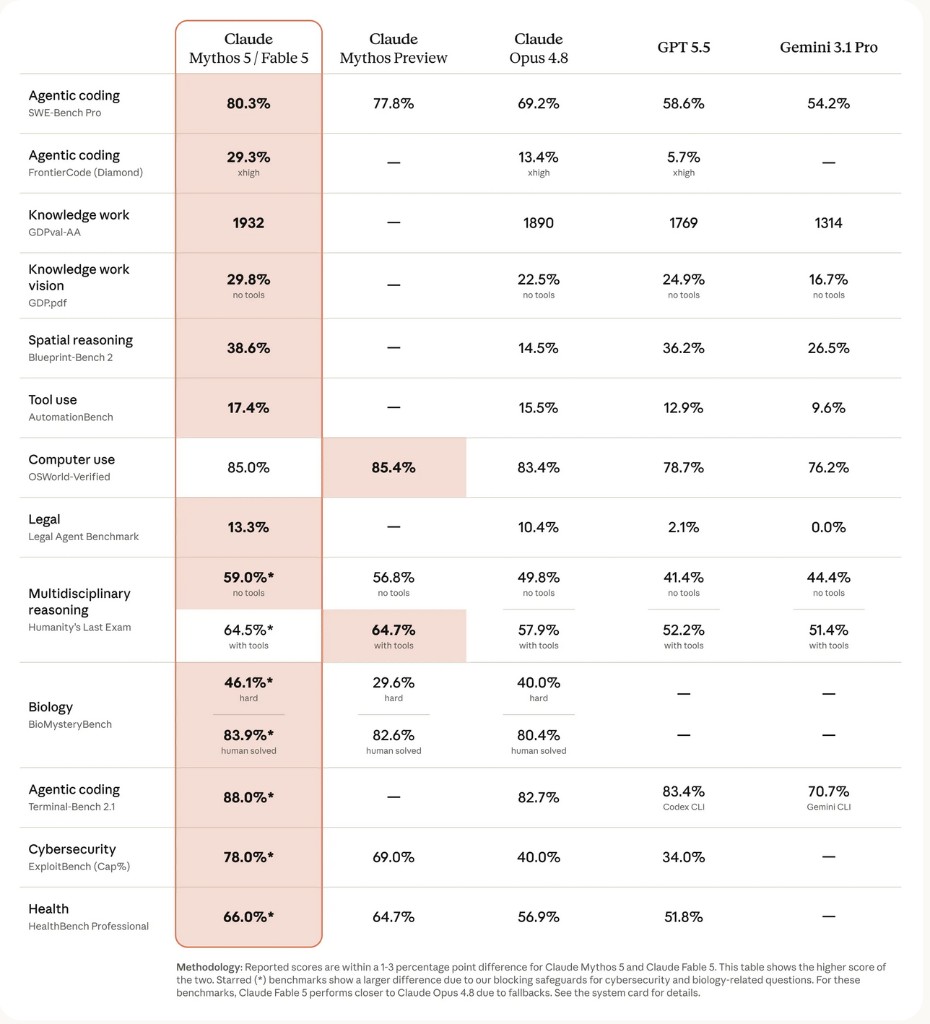
Agentic coding — SWE-Bench Pro: 80.3%
An 11-point jump over Opus 4.8 (69.2%) and far ahead of GPT 5.5 (58.6%) — the largest single-generation gain Anthropic has published for this benchmark.
Knowledge work — GDPval-AA: 1932
The highest knowledge-work score in the table, ahead of Opus 4.8 (1890), GPT 5.5 (1769) and Gemini 3.1 Pro (1314).
Multidisciplinary reasoning — Humanity's Last Exam: 64.5% (with tools)
59.0% without tools and 64.5% with tools — clearly ahead of Opus 4.8 (49.8% / 57.9%) and GPT 5.5 (41.4% / 52.2%).
Terminal coding — Terminal-Bench 2.1: 88.0%
Ahead of Opus 4.8 (82.7%), Codex CLI with GPT 5.5 (83.4%) and Gemini CLI (70.7%) on real terminal-based engineering tasks.
Benchmarks and methodology: Anthropic — Claude Fable 5 and Claude Mythos 5
New safety architecture
A model this capable comes with risks. Anthropic ships Fable 5 with a new set of safety classifiers covering cybersecurity, biology/chemistry and model distillation. The classifiers were red-teamed extensively: an external bug bounty produced no universal jailbreaks in over 1,000 hours of testing.
When a classifier triggers, the request is automatically answered by Claude Opus 4.8 instead — and you are informed in the chat when this happens. Anthropic reports this affects fewer than 5% of sessions, and they are working to reduce false positives. A fallback to Opus 4.8 is still a frontier-quality answer — not a refusal.
Transparency: why Fable 5 is NON-ZDR
Fable 5 carries the NON-ZDR badge on AI·Collab. Anthropic requires 30-day data retention for all traffic on Mythos-class models — on every platform, including ours. This is a deliberate safety measure: the data helps Anthropic defend against novel jailbreaks and attacks that operate across many requests.
Anthropic commits to strict limits: the data is never used to train new models, never used for any non-safety purpose, all human access is logged, and deletion after 30 days is ensured in almost all cases. Our ZDR models (the large majority of our catalog) remain fully zero-data-retention — the choice is always yours, per chat, per task.
How ZDR works on AI·CollabHow to use Fable 5 on AI·Collab
Fable 5 is available to all AI·Collab users from today. No setup required.
Add it under My Custom Models
Open Account Settings → My Custom Models and add the model. Then select it from the model picker in chat.aicollab.app — search for "Fable".
Give it your hardest tasks
Fable 5 shines on long, complex work: large codebases, multi-document analysis, deep research. The longer the task, the larger its lead.
Know your data choice
Fable 5 is NON-ZDR (30-day Anthropic safety retention). For zero-retention work, pick any of our ZDR-badged models — they remain the default recommendation for sensitive data.
Pricing: $10 / $50 per million input / output tokens — less than half the price of Claude Mythos Preview, and the same as Opus 4.8 (Fast). On AI·Collab this is billed in credits as usual; you can see the exact credit rates on our models page.
Frequently asked questions
What is a Mythos-class model?
Mythos-class is Anthropic's new top capability tier, above the Opus series. Claude Fable 5 is the same underlying model as Claude Mythos 5 — Fable is the generally available version with safety classifiers, while Mythos 5 (with some safeguards lifted) is restricted to vetted cyberdefense partners through a US-government collaboration called Project Glasswing.
Why does Fable 5 have the NON-ZDR badge?
Anthropic requires 30-day data retention for all Mythos-class traffic, on all platforms, strictly for safety monitoring. The data is never used for training, all human access is logged, and deletion after 30 days is ensured in almost all cases. If you need zero data retention, choose one of our many ZDR-badged models instead — details at aicollab.app/zdrp/.
What happens when a safety classifier triggers?
Your request is automatically answered by Claude Opus 4.8 instead of Fable 5, and you are informed in the chat. This affects fewer than 5% of sessions — mostly topics around cybersecurity, biology/chemistry and model distillation. Opus 4.8 is a frontier model in its own right, so you still get a high-quality answer rather than a refusal.
What does Fable 5 cost on AI·Collab?
Anthropic prices Fable 5 at $10 per million input tokens and $50 per million output tokens — the same as Opus 4.8 (Fast) and less than half the price of Mythos Preview. On AI·Collab this is billed in credits as usual; exact credit rates are on the models page.
Should I switch all my work to Fable 5?
For long, complex tasks — large refactorings, deep document analysis, research — Fable 5 is the strongest model available. For everyday tasks, faster and cheaper models often serve you better, and for sensitive data we recommend ZDR models. Our Auto Router can also pick the right model for each prompt automatically.
Is Claude Mythos 5 available on AI·Collab?
No. Mythos 5 is restricted to vetted cyberdefense and infrastructure partners in Anthropic's Project Glasswing and is not available via API resellers or platforms. Fable 5 — the same model with safety classifiers — is the generally available version, and it is live on AI·Collab now.
Benchmark figures and capability claims are taken from Anthropic's official announcement of June 9, 2026 and have not been independently verified by AI·Collab. The benchmark table image is © Anthropic and is reproduced for reporting purposes with source attribution. Model availability and pricing are subject to change.
Related Articles
Claude Fable 5.1 is live on AI·Collab — new frontier, ~25% cheaper to run
Anthropic's strongest model yet: ahead of Opus 5 on every benchmark, double Fable 5 on agentic science — and cheaper in practice thanks to a 75% cut in cache-read pricing. Plus what NON-ZDR means for your data.
Read moreClaude Opus 5 is live on AI·Collab — near Fable 5 at Opus price
Anthropic's everyday frontier model: SOTA Frontier-Bench, a leap on ARC-AGI-3, and leading business workflows — standard and Fast, at the same token price as Opus 4.8.
Read moreClaude Sonnet 5 is live on AI·Collab — cheaper and more agentic than 4.6
Anthropic's most agentic Sonnet yet, priced below Sonnet 4.6 with performance approaching Opus 4.8. Now available on AI·Collab.
Read moreReady to Experience 300+ AI Models?
Get started today. Access models from OpenAI, Google, Anthropic, Grok and more.
GDPR compliant · Zero data retention · Cancel anytime