We Use Cookies
We use cookies to enhance your browsing experience, analyze site traffic, and personalize content. By clicking "Accept All", you consent to our use of cookies. You can customize your preferences or reject non-essential cookies.
Learn more about our cookie policyGPT-5.6 Terra is live on AI·Collab
OpenAI's balanced GPT-5.6 model is now a Platform Model for every user — it supersedes GPT-5.5 at roughly half the credit price, with Sol and Luna available via My Custom Models.
What we shipped
OpenAI released the GPT-5.6 family for general availability on July 9, 2026 — a three-tier generation: Sol (flagship), Terra (balanced everyday model), and Luna (fastest and most affordable). GPT-5.6 sets a new bar for intelligence and efficiency, reaching state-of-the-art results across coding, knowledge work, cybersecurity and science while using fewer tokens at lower cost. On AI·Collab we've made GPT-5.6 Terra the new default Platform Model for every user. It replaces GPT-5.5 as the everyday OpenAI option — comparable performance, at roughly half the credit price.
In the model picker, look for OpenAI: GPT-5.6 Terra. It's ZDR-labeled on AI·Collab and supports a ~1M-token context window. Prefer the flagship or the cheapest tier? Sol and Luna are available under My Custom Models (Meine benutzerdefinierten Modelle).
One generation, three tiers
GPT-5.6 ships as durable capability tiers rather than a single model — the number marks the generation, while Sol, Terra and Luna advance on their own cadence. Pick the tier that matches the job.
Terra — Platform default
The balanced everyday model, added as a Platform Model for all users. Performance competitive with GPT-5.5 at about half the price — ideal for analysis, coding help, document work and routing defaults.
Sol — flagship
OpenAI's most capable GPT-5.6 model for the hardest, deeply agentic work: long-running coding, security research and multi-agent tasks. Available via My Custom Models.
Luna — fastest & cheapest
Frontier-adjacent capability at the lowest cost — great for summarization, drafting and high-volume routine automation. Available via My Custom Models.
Half the price of GPT-5.5
GPT-5.6 introduces a cleaner three-tier price structure. On AI·Collab, Terra lands at roughly half the credit price of GPT-5.5 for both input and output, while matching it on quality — and Luna is dramatically cheaper still.
| Model | Input (credits / 1M tokens) | Output (credits / 1M tokens) | Context |
|---|---|---|---|
| GPT-5.6 Terra | 3,036 credits | 18,216 credits | 1M tokens |
| GPT-5.5 | 6,072 credits | 36,432 credits | 1M tokens |
| GPT-5.6 Luna | 1,214 credits | 7,286 credits | 1M tokens |
| GPT-5.6 Sol | 6,072 credits | 36,432 credits | 1M tokens |
Live credit rates as shown in the AI·Collab model catalog (aicollab.app/models). Terra input and output are ≈50% cheaper than GPT-5.5; Luna is the lowest-cost tier of the family. Sol matches GPT-5.5 pricing at higher capability.
What's new in GPT-5.6
OpenAI positions GPT-5.6 around stronger performance per dollar — more successful work for the same spend, or comparable results at lower total cost. Most gains show up in sustained, multi-step agentic work.
Stronger agentic performance
GPT-5.6 plans and uses tools — web search, file search, functions and computer use — and completes long, complex tasks reliably. The new ultra setting coordinates multiple agents across parallel workstreams to finish demanding work faster.
State-of-the-art coding
The family leads agentic coding evaluations: Sol tops the Artificial Analysis Coding Agent Index, and both Sol and Terra outpace GPT-5.5 on Terminal-Bench 2.1 and DeepSWE, with Terra delivering most of that gain at half the cost.
More work per token
GPT-5.6 reaches comparable or better scores using far fewer output tokens than previous and competing frontier models — which translates directly into lower real-world cost per completed task.
Adjustable reasoning effort
Effort levels from none to max let you tune cost, latency and quality per task — dial up for hard problems, keep it low and fast for routine work. GPT-5.6 also adds more predictable prompt caching.
How it benchmarks
OpenAI's published charts place the GPT-5.6 family ahead of GPT-5.5 and competitive with much more expensive frontier models — while using a fraction of the tokens and cost.
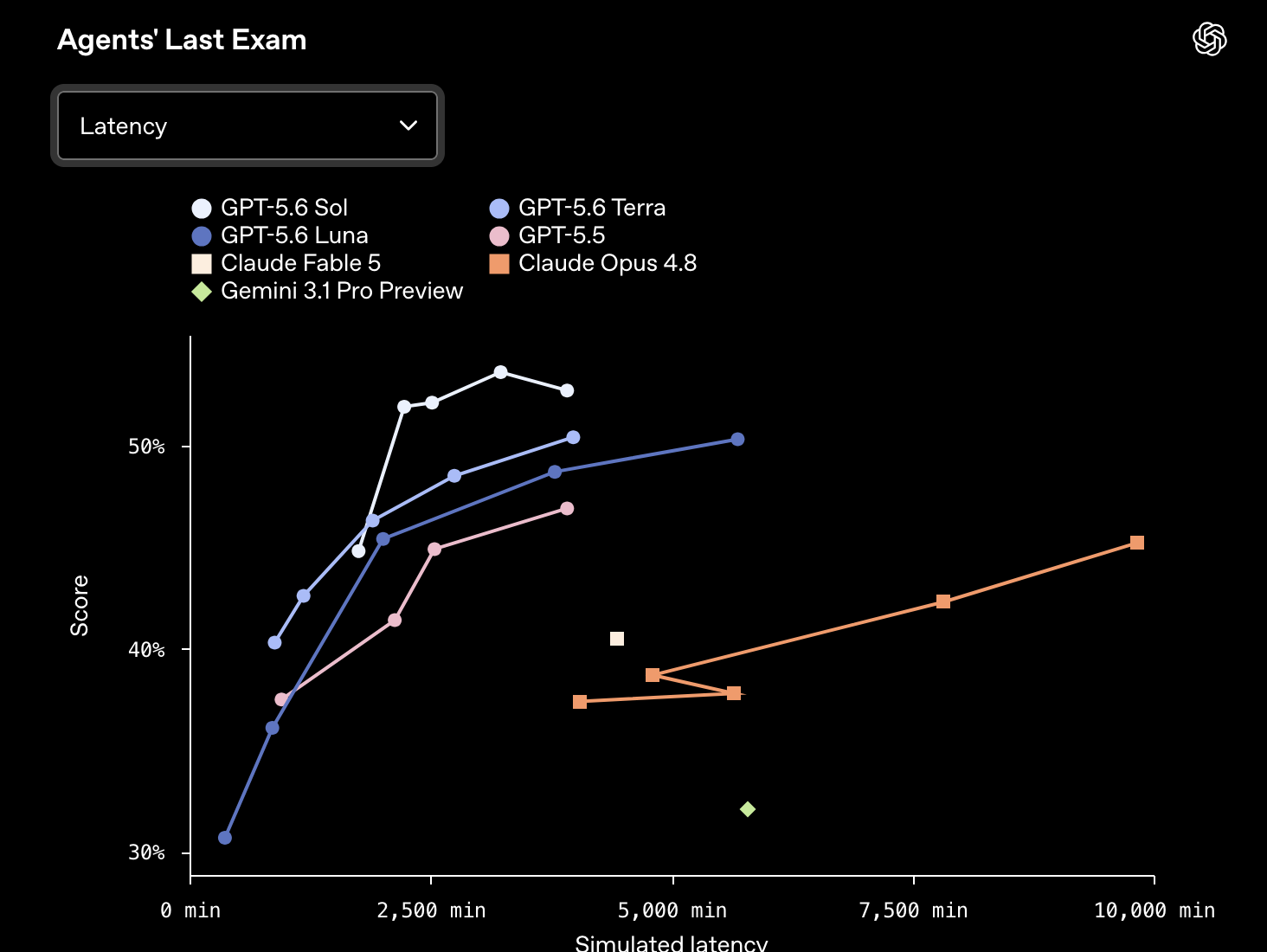
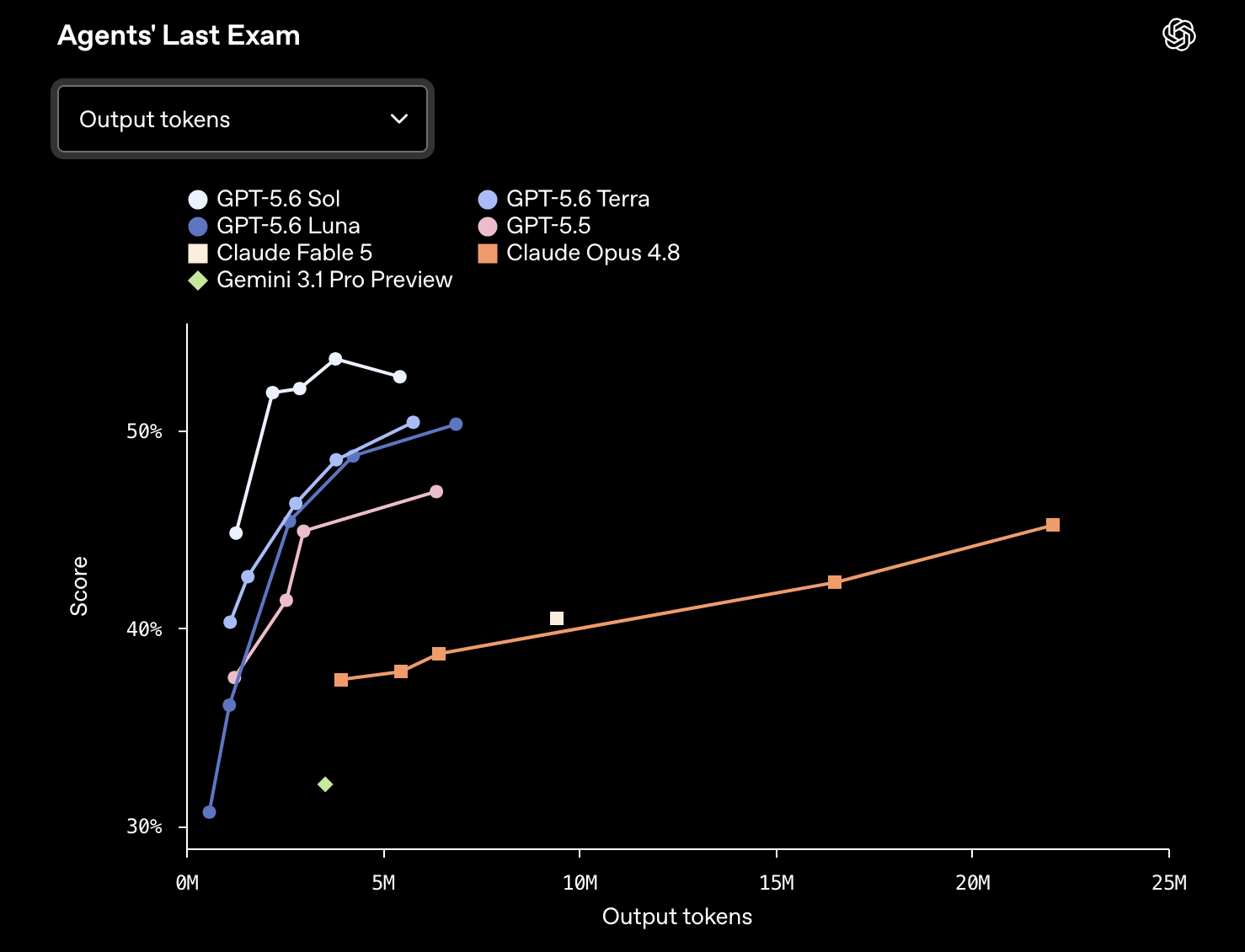
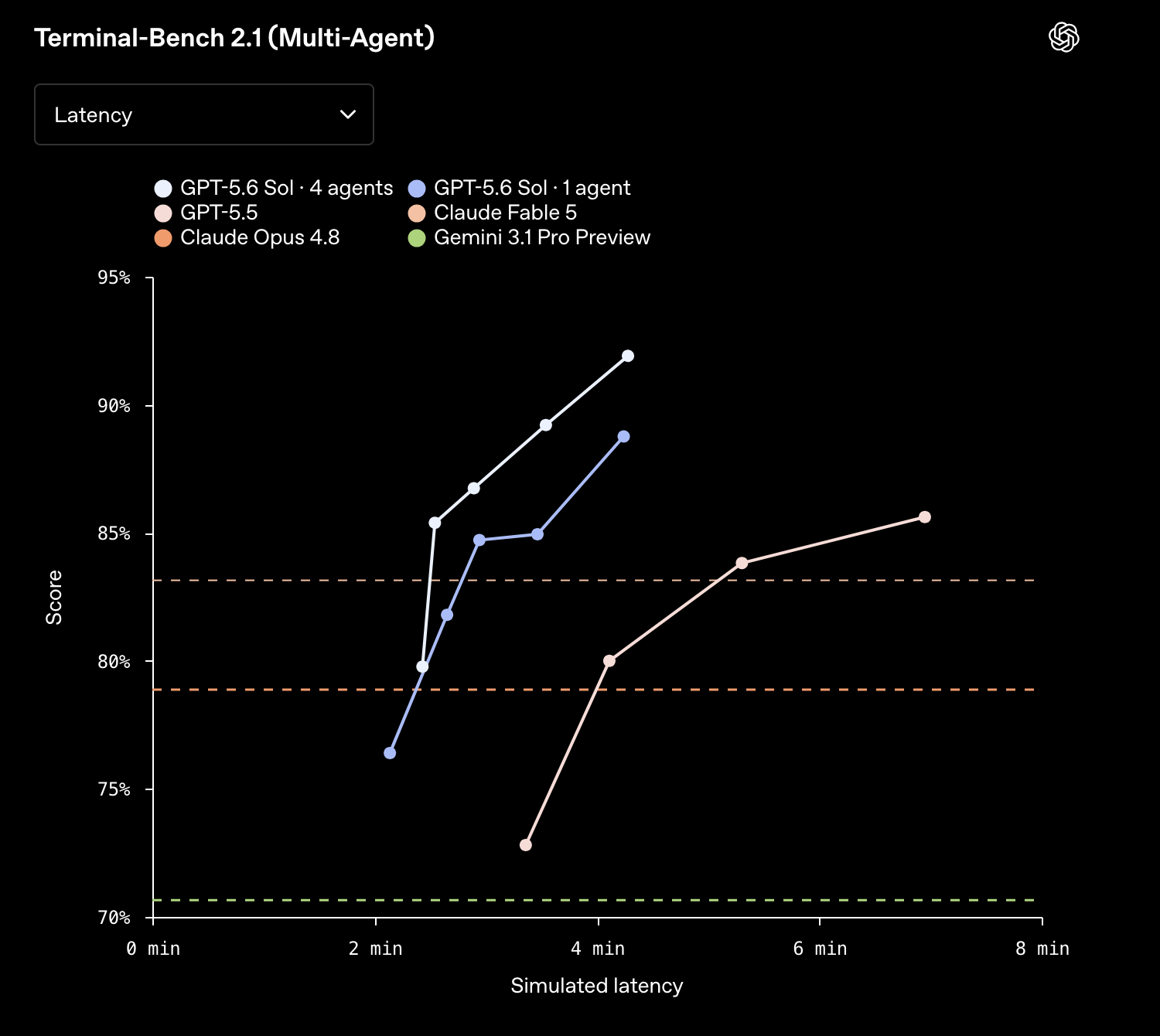
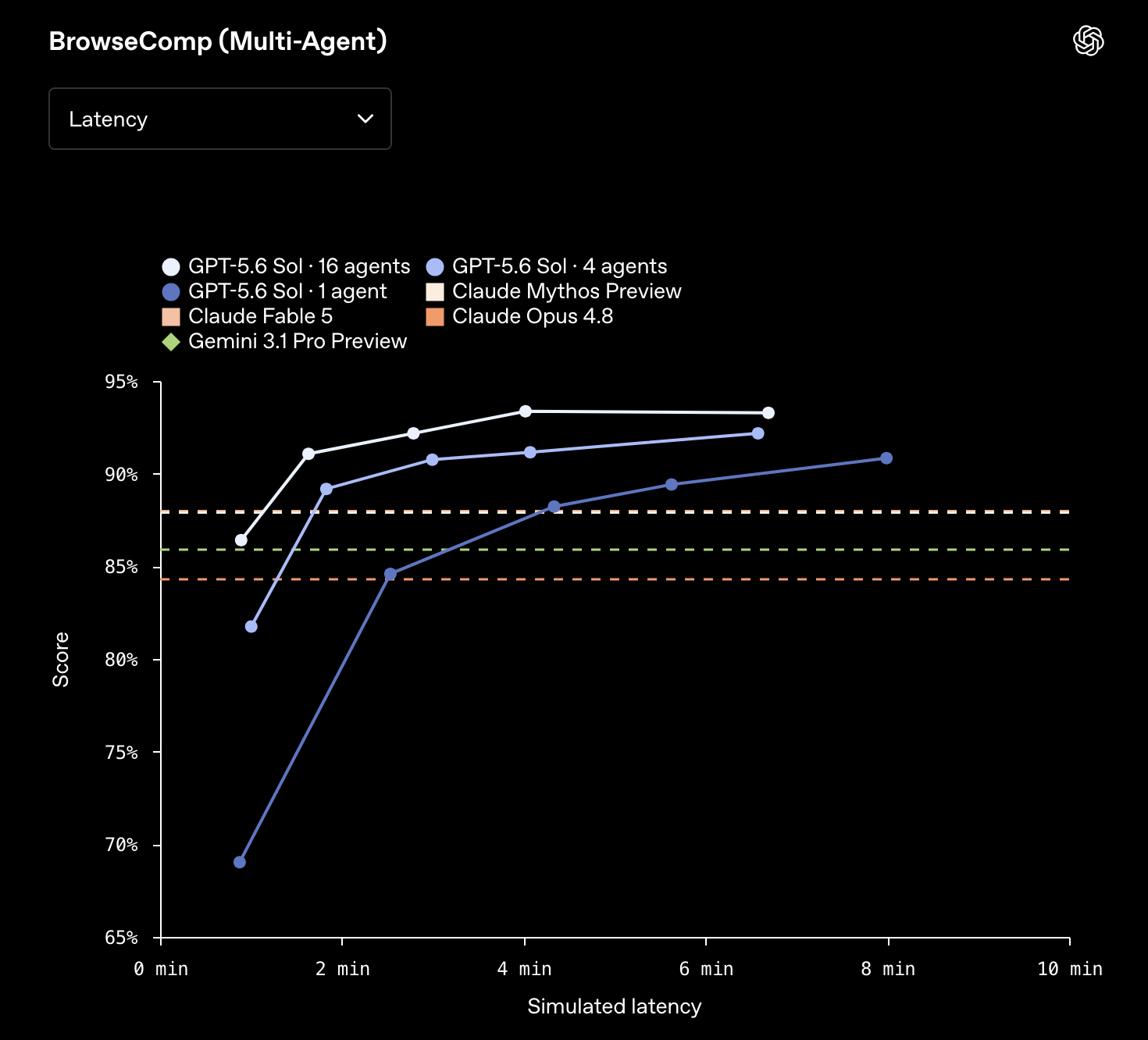
Terra: GPT-5.5 quality at half the price
GPT-5.6 Terra matches or beats GPT-5.5 across the family's benchmarks while costing about half as much on AI·Collab — a straight upgrade for everyday OpenAI work.
Sol closes on the frontier, efficiently
At higher effort and with multi-agent modes, Sol reaches or surpasses much pricier frontier models on agentic search and computer use — often using dramatically fewer output tokens, which keeps real cost low.
Benchmarks and methodology: OpenAI — GPT-5.6 (official announcement)
Charts © OpenAI, reproduced from the official GPT-5.6 announcement (openai.com/index/gpt-5-6/) for editorial reference. All trademarks and benchmark figures belong to OpenAI.
How to use GPT-5.6 on AI·Collab
No setup required — GPT-5.6 Terra is already in your model picker as a Platform Model.
Pick OpenAI: GPT-5.6 Terra
It's available to every user as a Platform Model. Select it in the model picker at chat.aicollab.app — search for "GPT-5.6" or "Terra".
Add Sol or Luna under My Custom Models
Want the flagship (Sol) or the cheapest tier (Luna)? Open Account Settings → My Custom Models (Meine benutzerdefinierten Modelle) and add them, then select from the picker.
Or let the Auto Router decide
Leave AutoPilot on and the router will route suitable prompts to the right GPT-5.6 tier automatically — no manual switching.
Live pricing on AI·Collab: Terra 3,036 credits input / 18,216 credits output per 1M tokens — about half of GPT-5.5's 6,072 / 36,432 credits. Luna is 1,214 / 7,286 and Sol is 6,072 / 36,432. Billed transparently in credits; the model catalog always shows the current rate.
FAQ
Is GPT-5.6 Terra available to everyone?
Yes. Terra is a Platform Model, available to every AI·Collab user — no setup needed. It replaces GPT-5.5 as the default everyday OpenAI model. Sol and Luna can be added under My Custom Models.
How much cheaper is Terra than GPT-5.5?
On AI·Collab, Terra is priced at 3,036 credits input / 18,216 credits output per 1M tokens, versus 6,072 / 36,432 for GPT-5.5 — roughly half the price on both input and output, at comparable or better quality.
What are Sol and Luna?
They're the other two GPT-5.6 tiers. Sol is the flagship for the hardest, deeply agentic work; Luna is the fastest and most affordable for high-volume routine tasks. Both are available via My Custom Models.
Is GPT-5.6 ZDR on AI·Collab?
Yes — the GPT-5.6 models carry the ZDR label on AI·Collab. Always check the model catalog for the current ZDR/EU-hosting status per model.
What context window does GPT-5.6 Terra support?
Approximately 1,000,000 tokens (about 1.05M), in line with the current-generation OpenAI models on AI·Collab.
Benchmark figures are from OpenAI's published GPT-5.6 announcement and pricing reflects the AI·Collab model catalog at publish time. Charts are © OpenAI and reproduced for editorial reference. Credit rates and model labels can change — the model catalog is always the authoritative source for live prices and availability.
Related Articles
Claude Opus 5 is live on AI·Collab — near Fable 5 at Opus price
Anthropic's everyday frontier model: SOTA Frontier-Bench, a leap on ARC-AGI-3, and leading business workflows — standard and Fast, at the same token price as Opus 4.8.
Read moreClaude Sonnet 5 is live on AI·Collab — cheaper and more agentic than 4.6
Anthropic's most agentic Sonnet yet, priced below Sonnet 4.6 with performance approaching Opus 4.8. Now available on AI·Collab.
Read moreWhat Are AI Credits — and What Do They Cost?
Credits explained: real cost data for GPT-5.4, Claude Opus, Gemini 3.1 Pro, Perplexity Sonar Pro and more. See how far 3,000 or 15,000 credits take you.
Read moreReady to Experience 300+ AI Models?
Get started today. Access models from OpenAI, Google, Anthropic, Grok and more.
GDPR compliant · Zero data retention · Cancel anytime