We Use Cookies
We use cookies to enhance your browsing experience, analyze site traffic, and personalize content. By clicking "Accept All", you consent to our use of cookies. You can customize your preferences or reject non-essential cookies.
Learn more about our cookie policyClaude Sonnet 5.5 is live on AI·Collab
Anthropic's fastest Sonnet yet: 30%+ faster than Sonnet 5, dramatically stronger at agentic coding, near-Opus knowledge work — with a 1M-token context window, ZDR routing and native tools on AI·Collab.
A practical frontier model for everyday work
Anthropic released Claude Sonnet 5.5 on September 28, 2026. It is a clear upgrade over Sonnet 5, aimed at well-scoped everyday tasks: fixing bugs, iterating quickly, producing polished documents, presentations and spreadsheets, and working with visual material. It is also a much stronger coding agent. The largest published jump is Terminal-Bench 4.0, where Sonnet 5.5 scores 70.6% compared with 10.3% for Sonnet 5. Anthropic positions Opus 5.5 above it for complex, open-ended work requiring sustained judgment; Sonnet 5.5 is the faster, lower-cost complement.
On AI·Collab, search for “Claude Sonnet 5.5”. The regular model is live as PAID, ZDR and AGENTIC, with native tool calling, knowledge-base access and a 1M-token context window.
Faster output, fewer steps, lower task cost
Sonnet 5.5 keeps Sonnet 5's $2 input / $10 output price per million tokens, but Anthropic reports that it typically needs fewer tokens and fewer tool steps to complete the same work. In their testing, that reduced cost per task by up to 30%. External testers also report 14% fewer output tokens at Slack, one-third fewer tool calls at Lovable, and support tickets processed 20% faster at Zendesk.
30%+
faster generation than Sonnet 5
up to 30%
lower cost per completed task
1M
tokens of context on AI·Collab
Published benchmark results
The official benchmark table shows broad gains over Sonnet 5. At maximum effort, some results approach Opus 5.5, but Anthropic is explicit that Opus remains stronger for ambiguous, open-ended work. Benchmark results are useful signals, not guarantees for every workload.
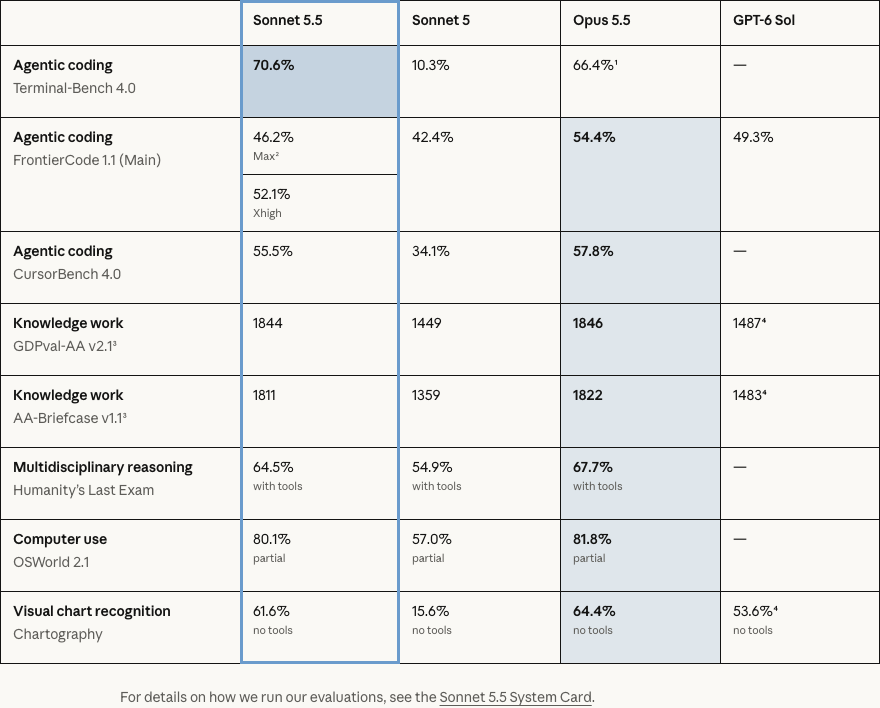
Terminal-Bench 4.0 — 70.6%
A dramatic rise from Sonnet 5's 10.3%, and above the reported Opus 5.5 score of 66.4%. This benchmark measures complex multi-step professional work in a terminal.
CursorBench 4.0 — 55.5%
Up from 34.1% for Sonnet 5 and within 2.3 points of Opus 5.5 at 57.8%. CursorBench uses ambiguous, multi-file tasks from real coding sessions.
GDPval-AA v2.1 — 1844
Nearly level with Opus 5.5 at 1846 and well ahead of Sonnet 5 at 1449. AA-Briefcase shows a similar pattern: 1811 versus 1822 for Opus 5.5.
OSWorld 80.1% · Chartography 61.6%
Computer use rises from 57.0% to 80.1%; visual chart recognition rises from 15.6% to 61.6%, supporting document, screenshot and chart-heavy workflows.
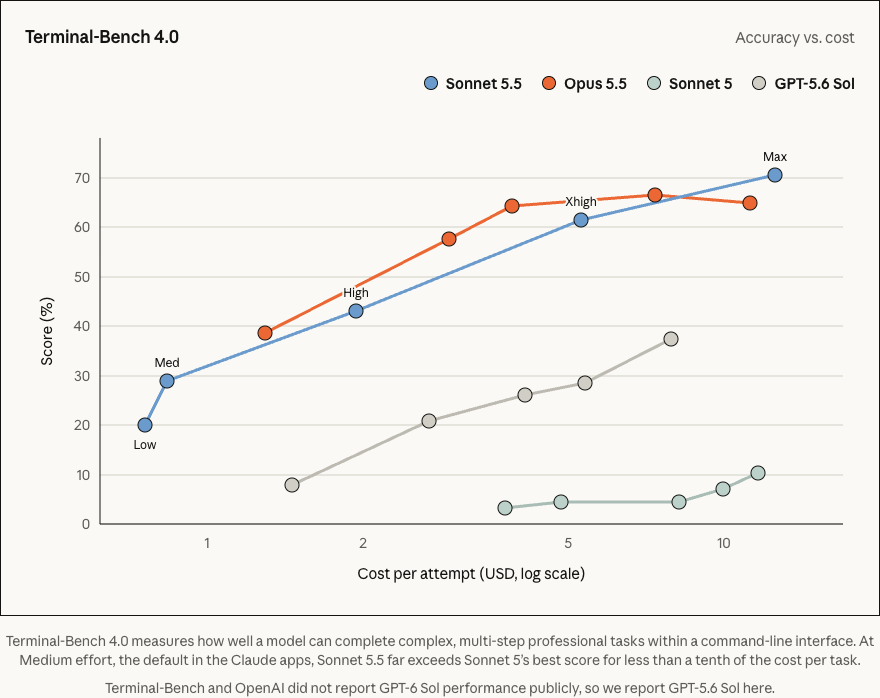
Benchmark table and chart © Anthropic, captured from the official Sonnet 5.5 announcement and reproduced for editorial reference.
Where Sonnet 5.5 fits
The model is optimized for fast collaboration rather than maximum deliberation. That makes it a strong default when tasks are clear, iteration speed matters and you still need frontier-level quality.
Coding and debugging
Fast codebase understanding, bug fixing, reviews and multi-file implementation. Early testers report fewer failed tool calls and less prescriptive prompting.
Knowledge work
Strong document drafting, analysis, support workflows and slide creation. Anthropic reports results close to Opus 5.5 on real occupational tasks.
Visual and design work
Improved image and chart understanding, polished UI generation and better adherence to presentation templates.
Agentic tools
Native function calling is verified on AI·Collab. Use it with memories, knowledge bases, notes and other tools for focused multi-step workflows.
ZDR on AI·Collab — with stronger safeguards
The regular OpenRouter model is currently labelled ZDR in the AI·Collab catalogue. AI·Collab routes it through the standard privacy-controlled model path; always use the live model card as the authoritative source because provider routing and labels can change.
Anthropic says Sonnet 5.5 is the first Sonnet to launch with cyber safeguards comparable to its most capable models, plus biology safeguards and protections against reasoning extraction. These target a narrow set of high-risk requests; ordinary software development and most life-sciences work are unaffected.
How to use Sonnet 5.5 on AI·Collab
The model is available now in the regular catalogue — no EU preview route is required.
Add it to My Custom Models
Open Account Settings → My Custom Models and add Claude Sonnet 5.5.
Pick it for fast, scoped work
Use it for debugging, code review, document creation, charts and iterative tasks. For the hardest open-ended problems, compare it with Fable 5.1 or Opus-class models.
Check the live model card
The catalogue shows the current price, context window, ZDR status and availability. Those live values take precedence over launch-day copy.
Verified AI·Collab rate at launch: 2,428 input credits and 12,144 output credits per 1M tokens. Upstream list price: $2 input / $10 output; cache reads $0.20; cache writes $2.50.
Frequently asked questions
How is Sonnet 5.5 different from Sonnet 5?
It is more than a speed refresh. Anthropic reports 30%+ faster output, much higher agentic-coding scores, better knowledge work, stronger image/chart understanding and fewer tokens or tool steps for many tasks. Token list pricing remains $2 / $10 per million input/output tokens.
Should I use Sonnet 5.5 or Fable 5.1?
Use Sonnet 5.5 for fast, well-scoped everyday coding and knowledge work. Use Fable 5.1 when a long, difficult, open-ended agent run justifies higher cost and its NON-ZDR retention policy is acceptable. The live catalogue shows current labels and prices.
Is Sonnet 5.5 ZDR on AI·Collab?
Yes, the regular model is currently labelled ZDR in the AI·Collab catalogue. This is distinct from the separate OpenRouter EU preview. Always confirm the current label on the live model card before sensitive work.
Does Sonnet 5.5 support tools and knowledge bases?
Yes. AI·Collab has verified native function calling for anthropic/claude-sonnet-5.5, and the model is marked AGENTIC. It can use AI·Collab tools such as memories and knowledge bases when enabled.
What does Sonnet 5.5 cost on AI·Collab?
At launch the verified rate is 2,428 input credits and 12,144 output credits per million tokens. Anthropic's upstream list price is $2 / $10. Consult the models page for the current live rate.
What is the context window?
The live AI·Collab catalogue reports a 1,000,000-token context window for Claude Sonnet 5.5.
Benchmark and third-party customer figures are reported by Anthropic in its September 28, 2026 announcement and have not been independently verified by AI·Collab. Images are © Anthropic and reproduced for editorial reference. Prices, context limits and privacy labels can change; the live model catalogue is authoritative.
Related Articles
Gemini 4 Argon on AI·Collab — knowledge work, coding and long context
Google's new sparse MoE model: evidence-led legal and finance drafts, coding, multimodal understanding, balanced benchmarks, PAID/ZDR and practical limits.
Read moreGPT-6.1 Sol is available on AI·Collab
Near-Astra capability, 1.05M context and ZDR: verified credit prices, coding and document benchmarks, practical guidance and FAQ.
Read moreClaude Sonnet 5 is live on AI·Collab — cheaper and more agentic than 4.6
Anthropic's most agentic Sonnet yet, priced below Sonnet 4.6 with performance approaching Opus 4.8. Now available on AI·Collab.
Read moreClaude Fable 5.1 is live on AI·Collab — new frontier, ~25% cheaper to run
Anthropic's strongest model yet: ahead of Opus 5 on every benchmark, double Fable 5 on agentic science — and cheaper in practice thanks to a 75% cut in cache-read pricing. Plus what NON-ZDR means for your data.
Read moreWhat Are AI Credits — and What Do They Cost?
Credits explained: real cost data for GPT-5.4, Claude Opus, Gemini 3.1 Pro, Perplexity Sonar Pro and more. See how far 3,000 or 15,000 credits take you.
Read moreReady to Experience 300+ AI Models?
Get started today. Access models from OpenAI, Google, Anthropic, Grok and more.
GDPR compliant · Zero data retention · Cancel anytime