We Use Cookies
We use cookies to enhance your browsing experience, analyze site traffic, and personalize content. By clicking "Accept All", you consent to our use of cookies. You can customize your preferences or reject non-essential cookies.
Learn more about our cookie policyPrivacy-First Voice: Your Voice Stays in Europe with Local Whisper AI
How AI·Collab protects your voice with local-first speech recognition and EU-only failover — GDPR-compliant voice AI that puts privacy first
The Voice Data Dilemma
Voice assistants are convenient, but your voice is extremely personal data. Every spoken word sent to cloud services for speech recognition. The risk? Voice recordings stored on foreign servers, potentially analyzed or used for training. GDPR concern: Voice data is biometric data — the highest privacy risk category. Can you use voice-to-text AI without sending your voice to Big Tech? Answer: Yes. At AI·Collab, your voice stays in Europe — or never leaves your local network.
Privacy-First Voice Recognition with Whisper AI
At AI·Collab, we built a dual-layer speech-to-text system that prioritizes privacy, performance, and reliability.
├─ Location: Local server (your infrastructure)
├─ Privacy: Audio NEVER leaves your network
└─ Cost: 100% FREE
├─ Location: Stockholm, Sweden (EU)
├─ Privacy: GDPR-compliant, EU data residency
└─ Retention: Zero storage — deleted immediately
What This Means for You:
- 95% of the time: Your voice never leaves your local network (maximum privacy)
- 5% failover: When needed, data stays in EU (Sweden Central)
- Zero retention: Audio is transcribed and immediately deleted
- No training: Your voice is NEVER used to train AI models
- GDPR compliant: Full European data residency
What Is Whisper?
Whisper is OpenAI's open-source speech recognition AI — the same technology behind ChatGPT's voice features.
Why We Chose Whisper:
- State-of-the-art accuracy: Understands 99+ languages
- Open source: Transparent, auditable, no vendor lock-in
- Self-hostable: We run it on our own infrastructure
- Fast: Transcribes 10 seconds of audio in under 1 second
How to Use Voice-to-Text in OpenWebUI
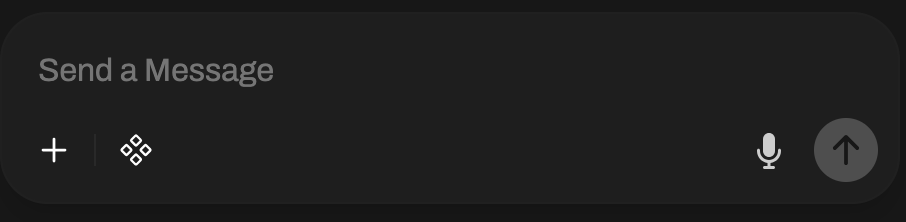
The microphone icon enables instant voice-to-text transcription
Step-by-Step:
- Open chat.aicollab.app in your browser
- Look for the microphone icon (🎤) at the bottom of the chat interface
- Click the microphone to start recording
- Speak your message (supports 99+ languages)
- Click again to stop — your voice is instantly transcribed
Important: Browser Permissions (Quick Setup)
Your browser will ask for microphone permission — this is normal and required.
On Desktop (Chrome/Firefox/Safari):
- Click the microphone icon
- Browser shows permission prompt: "Allow chat.aicollab.app to use your microphone?"
- Click "Allow" — future recordings work instantly
On Mobile (iOS/Android):
- Click the microphone icon
- Browser asks for microphone access
- Tap "Allow" in the popup
- If blocked: iOS: Settings → Safari → chat.aicollab.app → Microphone → Allow | Android: Settings → Apps → Browser → Permissions → Microphone → Allow
Privacy note: The browser itself handles audio recording — we only receive the final audio file for transcription, not continuous microphone access.
Real-World Use Cases
Scenario 1: The Busy Executive
Marco (CEO) is driving to a meeting and needs to draft an email. He opens chat.aicollab.app on his phone, taps the microphone, and speaks: "Draft an email to the board about Q1 results — revenue up 23%, focus on EMEA expansion."
Voice transcribed in <1 second. AI generates email draft. Privacy: Voice never left European infrastructure. ✅
Scenario 2: The Multilingual Team
Sophie (France), Hans (Germany), Maria (Spain) collaborate on a project. Each speaks in their native language using voice-to-text.
Sophie speaks French → transcribed perfectly. Hans speaks German → transcribed perfectly. Maria speaks Spanish → transcribed perfectly. All voice data stays in EU. ✅
Scenario 3: The Compliance Officer
Legal team needs voice-enabled AI but has GDPR concerns about traditional voice assistants (Alexa, Google, Siri) sending audio to US servers.
95% of transcriptions happen on local server (never leave building). 5% failover uses Sweden Central (EU jurisdiction). Zero retention policy. Pass compliance audit. ✅
Why Privacy Matters for Voice Data
Voice is biometric data under GDPR — the highest sensitivity level.
What voice data reveals:
- 🔍 Identity (voiceprint is like a fingerprint)
- 🔍 Health conditions (voice patterns can indicate illness)
- 🔍 Emotional state (stress, anxiety detectable in voice)
- 🔍 Location (background noise, accents)
AI·Collab approach:
- Local-first: 95% of voice never leaves your network
- EU failover: Remaining 5% stays in Sweden (GDPR jurisdiction)
- Zero retention: Audio deleted after transcription
- Transparent: You know exactly where your data goes
Who This Is For
✅ Privacy-conscious professionals
✅ European businesses (GDPR requirements)
✅ Healthcare professionals (patient confidentiality)
✅ Legal teams (attorney-client privilege)
✅ Journalists (source protection)
✅ Anyone who values data sovereignty
Related Articles
Temporary chats aren't erased: 30 days, 72 hours, and your GDPR register
What ChatGPT, Claude, and Gemini actually keep when you use "temporary" modes — and why storage limitation matters for DPIAs and subprocessors. How AI·Collab uses ZDR and EU hosting instead.
Read morePrivacy-First AI: Automatic PII Protection & Content Filtering
How AI·Collab protects your privacy with automatic PII redaction and content filtering — GDPR-compliant AI that puts security first.
Read moreNew: EU-based Routing & EU-hosted AI Models
European routing for EU-hosted model inference (Azure Sweden Central) — why it matters for GDPR, audits, and procurement.
Read moreReady to Experience 300+ AI Models?
Get started today. Access models from OpenAI, Google, Anthropic, Grok and more.
GDPR compliant · Zero data retention · Cancel anytime